How to Cancel Any Gym Membership: The Playbook That Works
Gyms make quitting harder than joining. Here is the universal playbook: find the contract terms, use the required channel, keep proof, and escalate correctly if billing continues.
Gym cancellations follow a pattern: signup is instant, but quitting requires a specific channel, a specific deadline, and sometimes a specific piece of paper. This playbook works for nearly any gym, from big chains to local clubs.
The quick answer
- Read your agreement first: find the required cancellation method, notice period, and any minimum term or buyout fee
- Use the exact channel the contract names (in person, certified mail, or online), not phone promises
- Get proof: a signed form copy, certified mail receipt, or confirmation email
- Mind the notice period: most gyms need 7 to 30 days before your billing date
- If billing continues, escalate with your proof: gym manager > corporate > card dispute > state consumer protection
Key facts at a glance
| Question | Answer |
|---|---|
| First thing to check | Your agreement: required method, notice period, minimum term, buyout fee |
| The channel that counts | Exactly what the contract names: in person, certified mail, or online |
| Typical notice period | 7 to 30 days before your billing date |
| Proof to keep | Signed form copy, certified-mail return receipt, or confirmation email, until two clean billing cycles pass |
| Phone cancellations | Not reliable; always get written confirmation |
| If billing continues | Manager > corporate > card dispute > state consumer protection, with proof attached |
| Special exits | Relocation, disability, or club-closure clauses may waive the buyout |
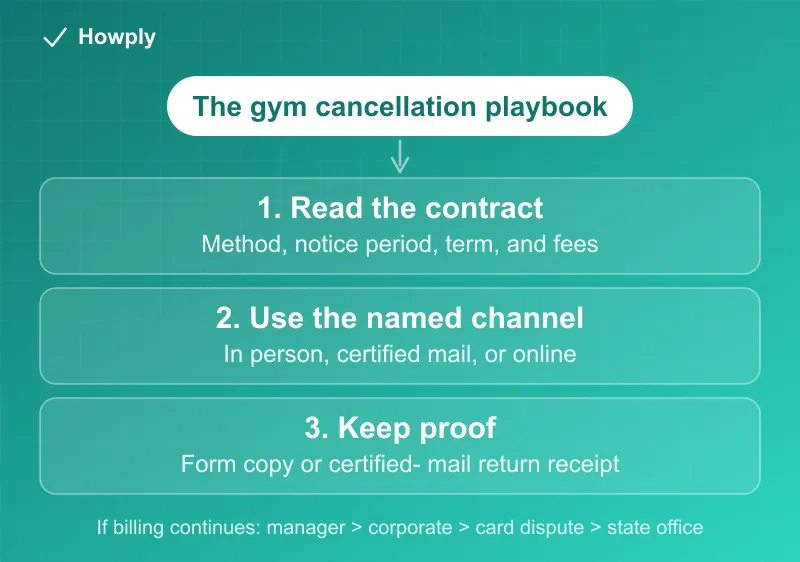
Step 1: Find your real obligations
Dig up your membership agreement (ask the front desk for a copy if you lost it; they must have it on file). Look for four things: the cancellation method the contract requires, the notice period, whether you are in a minimum term with a buyout fee, and the annual fee date. Everything else in this playbook depends on those four lines.
Step 2: Cancel through the required channel
- In person: ask for the cancellation form, complete it, and take a copy with the staff signature or stamp. This is the strongest proof you can get
- Certified mail: required by many chains for remote cancellation. Include your name, member ID, address, and a clear cancellation statement; pay for the return receipt
- Online: a growing number of gyms offer it (check your member portal first; it is always worth looking before a trip)
Verbal cancellations by phone are where memberships go to survive. If someone says “you’re all set” on a call, ask for written confirmation anyway.
For a chain-specific walkthrough, see our Planet Fitness cancellation guide.
Step 3: Keep proof like you will need it
Because you might. Keep the form copy, the certified mail receipt, or the confirmation email until you have seen two clean billing cycles. Note the date, location, and the staff member’s name if you canceled in person.
Step 4: If they keep charging you
Work up the ladder, attaching your proof at each step:
- Club manager, in writing (email creates a record)
- Corporate customer service for chains
- Card or bank dispute: with cancellation proof, a chargeback for post-cancellation billing is a strong claim
- Your state’s consumer protection office or attorney general: many states regulate health club contracts specifically, including cancellation rights, and complaints get responses
Moving, injured, or the gym changed?
Many membership agreements and some state health club laws provide cancellation rights if you move beyond a certain distance from the club, develop a disabling condition, or if the facility closes or materially changes. Check your agreement’s fine print for a relocation or disability clause before paying any buyout fee.
Bottom line
The gym’s power comes from friction and lost paperwork. Read the agreement, use the exact required channel, keep the receipt, and escalate with documents instead of arguments. It is rarely fast, but done this way it is nearly always final.
General guidance verified against major gym chains’ published policies as of July 2026. Contracts and state rules vary, so your agreement is the controlling document. This guide will be updated as chain policies change.