NYC Click-to-Cancel Rule: What Changed October 1 and How to Complain
New York City's click-to-cancel rule took effect October 1, 2026. Cancel the way you signed up, renewal notice timing, fines from $525, and how to file a DCWP complaint.
As of October 1, 2026, New York City has its own click-to-cancel rule. The city’s rule page says “As of October 1, 2026, you can file a complaint against businesses that make it hard to cancel subscriptions,” and the Mayor’s office says “New York City is the first municipality in the country to implement a Click-to-Cancel rule.” The Department of Consumer and Worker Protection (DCWP) enforces it, with fines that start at $525. This guide covers what the rule actually requires, the dates for renewal and price-change notices, who is exempt, why your first cancellation attempt matters for a refund, and how to file a complaint.
The quick answer
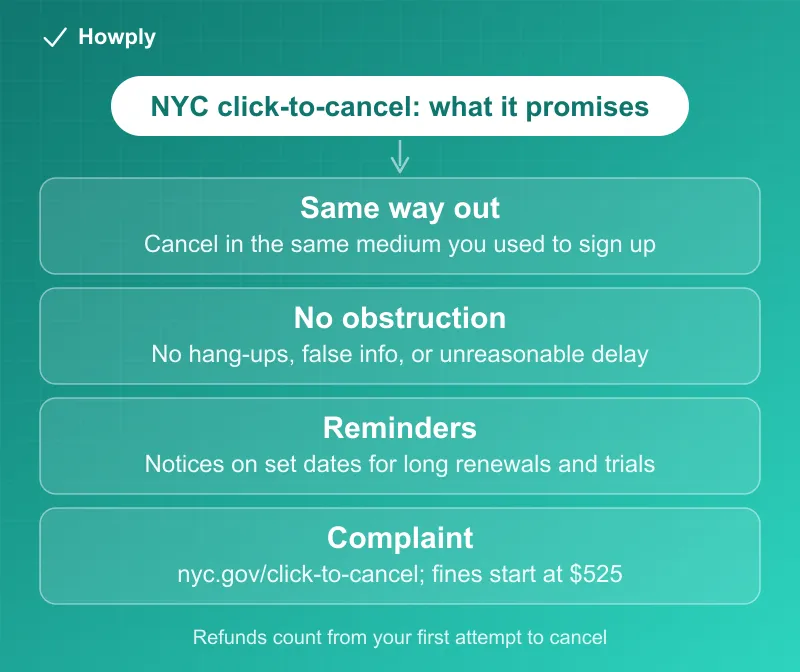
- The core rule: a company must give you “a simple cancellation mechanism that is as easy to use as the mechanism that the consumer used to provide consent” and “through the same medium that the consumer used to provide consent”
- No obstruction: companies cannot impose “unreasonable or unlawful conditions” or “unreasonably delay cancellation requests.” The rule names hanging up on a caller, giving false information about how to cancel, and misstating the cost of canceling
- Refund: a company that violates the rule “is liable for the monetary amount charged for the automatic renewal or continuous service offer after the consumer’s first attempt at cancellation”
- Fines: $525 for a first violation, $1,050 for a second, and $3,500 for a third and each one after
- Reminders: set notice windows for long renewals, price changes, and free trials longer than a month (below)
- Complaints: file at nyc.gov/click-to-cancel, by mail, or by fax. DCWP says it can help with complaints about “businesses in New York City”
- Exempt: banks, credit unions, entities regulated by the Department of Financial Services, security alarm operators, service-contract sellers, and services provided under a franchise from a New York political subdivision
Key facts at a glance
| Question | Answer |
|---|---|
| Effective date | October 1, 2026 |
| Who enforces it | NYC Department of Consumer and Worker Protection (DCWP) |
| What it covers | Subscriptions that meet the definition of automatic renewal or continuous service, “for any type of goods or services” |
| Cancel how | Any time, through the same medium you used to sign up, and through every medium the business accepts consent by |
| Fines | $525, then $1,050, then $3,500 |
| Refund | Amounts charged after your first attempt to cancel |
| Complaint options | Online portal, mail, or fax; status by phone through 311 |
| Rule text | Title 6 of the Rules of the City of New York, Chapter 5, new Part 8 (sections 5-110 to 5-110.3) |
| Proposed and heard | Proposed April 8, 2026; public hearing May 8, 2026 |
What the rule requires
The rule is Part 8 of Chapter 5 of Title 6 of the Rules of the City of New York, published in DCWP’s notice of adoption. It says “It is a deceptive and unconscionable trade practice for any person to offer or provide an automatic renewal or continuous service to a consumer except in accordance with the requirements of this section.” A subscription counts if it fits either definition: an automatic renewal is “a plan or arrangement in which a paid subscription or purchasing agreement is automatically renewed at the end of a definite term for a subsequent term,” and a continuous service is “a plan or arrangement in which a subscription or purchasing agreement continues until the consumer cancels the service.”
Disclosure before you pay. Before asking for consent or billing information, a company must present “the material terms” in a clear and conspicuous way, including “a description of the product or service subject to renewal, the amount of the costs that will be charged, the frequency of charges, the deadline by date or frequency by which the consumer must act to prevent or stop further charges, and cancellation mechanisms.” If the offer includes a free trial or a temporary price, it must explain “how and when the price will change and the price or prices that will subsequently be charged to the consumer.”
Cancel the way you signed up. The company must offer cancellation “through all mediums by which the business allows a consumer to provide affirmative consent.” In practice:
| How you signed up | What the rule says you must be offered |
|---|---|
| On a website | A simple cancellation mechanism through that same medium, at any time |
| By phone | A way to cancel by phone, plus every other medium the company accepts sign-ups by |
| In person | An in-person option “where practical,” and also “an online mechanism, such as a website or email” |
No obstruction. A company “must not impose unreasonable or unlawful conditions upon, refuse to acknowledge, obstruct or unreasonably delay cancellation requests.” The rule lists “hanging up on consumers who call to cancel, obscuring or providing false information about how to cancel, misrepresenting the consequences or costs of cancellation, or misrepresenting the reasons for delays in processing consumers’ cancellation requests.”
Save offers are allowed, within limits. A company may present a discount, retention benefit, or information about the effect of canceling, but not one that “imposes unreasonable or unlawful conditions upon the consumer’s ability to cancel.” DCWP says the provision “is intended to be fully consistent with” the state’s General Business Law, and that the final rule includes “minor changes” to make that clear.
Unordered goods are a gift. If a company ships goods under a subscription without your affirmative consent, they are “deemed an unconditional gift to the consumer,” with no obligation “to the person, including, but not limited to, bearing the cost of, or responsibility for, shipping.” The city’s rule page puts it simply: “Companies cannot ask that you pay to ship them things they gave you for free.”
The reminder dates
The rule sets three notice windows. Each must go out in the way you chose, such as text, email, or an app notification, and the first and third must include instructions for canceling.
| Situation | When the notice is due |
|---|---|
| A plan with an initial paid term of a year or longer that renews for six months or longer | ”at least fifteen days before, but not more than forty-five days before, the cancellation deadline” |
| A material change to the terms, “including any price increases" | "at least five business days prior, but no more than thirty days prior, to the date of the change” |
| A free trial or free gift “for a period of more than a month” followed by a charge | ”at least three days before but not more than twenty-one days before the cancellation deadline for the first chargeable period” |
The renewal and free-trial reminders have those thresholds, so a trial of a month or less, or a long plan that renews for under six months, is not named in them. The price-change notice has no such threshold.
Fines and refunds
The penalty chart in the rule lists $525 for a first violation, $1,050 for a second, and $3,500 for a third and subsequent violation. The city’s page says “Businesses that violate the rule would be liable for civil penalties, starting at $525, and may be liable for refunding the consumer.”
The refund wording is the part to plan around: a violator “is liable for the monetary amount charged for the automatic renewal or continuous service offer after the consumer’s first attempt at cancellation.” The date of your first attempt is the starting line. Our suggestion, not a rule requirement: record it. Take a screenshot of the cancel page or the chat, note the date, the time, and the method, and save any confirmation email. If a company ignores that attempt and bills you again, that record is what ties the refund to a date.
Who is exempt, and who is covered
The rule exempts:
- “Any service provided by a business or its affiliate where either the business or its affiliate is doing business pursuant to a franchise issued by a political subdivision of New York State”
- “Any entity, or subsidiary or affiliate thereof, regulated by the Department of Financial Services”
- “Security system alarm operators licensed by New York State Department of State”
- “Banks, bank holding companies, and their subsidiaries and affiliates; credit unions; and other financial institutions licensed under state or federal law”
- Sellers and administrators of a service contract, as defined in the state Insurance Law
DCWP rejected a request to exempt telephone and wireless companies, writing that the industry comments “do not identify any federal law or regulation that imposes a Click to Cancel requirement.”
On scope, the rule’s text covers “any person” who makes an offer to “a consumer,” and it does not spell out how it applies to a company outside the city. The city’s complaint page says DCWP “can help you with complaints about businesses in New York City. For complaints about businesses elsewhere, contact the local consumer affairs office or the State Attorney General.” If your subscription is with a national service, assume a complaint to DCWP may not be the right door, and use the options in the last section.
How to file a complaint
The city’s page lists six situations that call for a complaint:
- “You were not clearly told the terms of the subscription.”
- “It was hard to cancel the subscription. For example, you signed up online, but were forced to cancel your subscription on the phone, in person, or another way.”
- “The business delayed canceling your subscription.”
- The business sent products you did not ask for and expected you to return or pay for them
- You were not informed of changes to the subscription terms
- You were not informed of auto-renewal
You can file at nyc.gov/click-to-cancel. The Mayor’s release says “New Yorkers can file complaints online, by mail or by fax.” After filing, “you will receive a complaint number which you can use to check the status of your complaint,” and “A mediator may be assigned to your complaint to look into the issue.” For status by phone, NYC311 says “Call 311 or 212-NEW-YORK (212-639-9675).”
Include an address or email. NYC311 warns: “If you don’t include your address or email with your service request, you won’t receive follow up. The Department of Consumer and Worker Protection (DCWP) will consider your complaint a tip.” For a complaint that can lead to a refund, bring your first-attempt record, the sign-up page or confirmation, and the charge dates.
Where this sits next to federal and state law
The federal picture is unsettled. The FTC’s 2024 click-to-cancel rule was vacated, and in March 2026 the FTC asked for public comment on whether to adopt “provisions of the vacated 2024 Rule or some other provisions.” The agency cites “more than 100,000 complaints in the past five years” about negative options. Our canceled but still charged guide covers the dispute route that works today.
New York State already had related laws, which the rule’s preamble lists: “New York State law requires that health clubs accept notice of cancellation of a membership through a website if the health club allows for a contract to be entered through a website,” and a second law that requires any business with an automatic renewal or continuous service offer to present terms, get affirmative consent, and provide a cancellation mechanism “as easy to use as the mechanism offered for consent.” The preamble also notes the state attorney general’s May 30, 2025 settlement with Equinox for $600,000 over difficulty canceling memberships, which our Equinox cancel guide covers.
Outside New York, DCWP’s preamble says several states “including Utah, Idaho, California, Massachusetts, Georgia, Minnesota, Colorado, Illinois, and Arkansas have passed laws requiring that consumers have the right to Click to Cancel subscriptions.”
If your subscription is not with an NYC business
- Cancel in the same way you signed up, and keep proof of the date. Our subscription cancel guides help you find every active charge
- If a charge continues after a documented cancellation, your bank can review it; see our guide to disputing a subscription charge with your bank
- For a business outside the city, the NYC311 page points to local consumer affairs offices or the State Attorney General
Quick answers to what people search
What is the NYC click-to-cancel rule? A city rule, in effect since October 1, 2026, that requires clear subscription terms and a cancellation method as easy as the sign-up method.
When did it take effect? October 1, 2026. It was proposed on April 8, 2026 and heard on May 8, 2026.
What are the fines? $525 for a first violation, $1,050 for a second, and $3,500 for a third and later.
Do I get a refund? The rule makes a violator liable for charges after your first attempt to cancel.
Does it apply to banks or insurers? Banks, credit unions, entities regulated by the Department of Financial Services, security alarm operators, and service contract sellers are exempt, and so are services provided under a franchise issued by a New York political subdivision.
How do I file a complaint? At nyc.gov/click-to-cancel, by mail, or by fax. Include your address or email so DCWP can follow up.
Is there a federal click-to-cancel rule? Not in force. The FTC’s 2024 version was vacated and the agency opened a new rulemaking in March 2026.
Bottom line
If you signed up for a subscription in New York City, you now have a city rule behind a simple demand: cancel the way you signed up, without hang-ups, false information, or delay. Write down the date of your first cancel attempt, because that is where any refund begins. If the company does not comply, file at nyc.gov/click-to-cancel, and add an address or email so the complaint is not treated as a tip. If the business is outside the city, DCWP points you to local consumer affairs offices or the State Attorney General.
Rule requirements, definitions, notice windows, exemptions, penalties, and the effective date are quoted from DCWP’s Notice of Adoption; the complaint process and categories from the city’s Click to Cancel page, the Mayor’s October 1, 2026 release, and the NYC311 article; and the federal background from the FTC’s Negative Option Rule page and March 2026 press release. All were read on October 3, 2026. This guide explains a city rule and is not legal advice; the rule text is the authority.
Official sources
- NYC.gov: NYC's "Click to Cancel" rule is now in effect (rights and complaint instructions)
- NYC Mayor's Office: Mayor Mamdani Tells Subscription Traps: Click-to-Cancel or Pay Up (October 1, 2026)
- NYC Department of Consumer and Worker Protection: Notice of Adoption of the Click to Cancel rule (PDF)
- NYC311: Click to Cancel Complaint
- FTC: Negative Option Rule (rulemaking history)
- FTC press release: FTC Seeks Public Comment in Response to Advance Notice of Proposed Rulemaking Regarding Negative Option Marketing Practices (March 2026)