Generic Drug Price-Fixing Settlement: How to Claim by November 9
Paid for certain generic prescriptions from 2009 to 2019? One consumer claim covers the Sandoz and Sun/Taro settlements. Proof of one purchase per drug is required.
If you paid for certain generic prescriptions between May 1, 2009 and December 31, 2019, whether a copay at the pharmacy or the full price, you may be able to claim money from two settlements in a large antitrust case. The official settlement website says “To participate in the settlements, you must submit a claim form online or by U.S. Mail so that it is submitted or postmarked by November 9, 2026.” One consumer claim covers both the Sandoz settlement ($275 million) and the Sun/Taro settlement ($200 million), which are shared with insurers and other third-party payers. This guide covers who is in, how to check your drugs, the proof the form requires, how the payment is calculated, and the separate state program that runs to March 2027.
The quick answer
- Deadline: November 9, 2026, online or postmarked. “Any late submissions will not receive any payment from the Settlements”
- Who is in: people who paid “some or all of the purchase price” of a named generic drug between May 1, 2009 and December 31, 2019, “other than for resale.” Purchases in Indiana and Ohio are outside the class, and consumers covered by Medicaid are excluded
- Proof is required. For each drug you list, you must submit a document showing that you purchased it at least once in the period. The dollar amount you list is your own total
- The payment is pro rata: each claimant’s share depends on the dollars paid for covered drugs, not on a flat amount. No amount per person is stated
- Money comes later, after the court approves distribution. The notice says funds will be distributed “likely in conjunction with the proceeds of other settlements”
- Filing is free. The site says you “need not sign up with a claims recovery firm or pay another firm”
- A separate state attorneys general program has its own website and a March 8, 2027 deadline
Key facts at a glance
| Question | Answer |
|---|---|
| Case | In re Generic Pharmaceuticals Antitrust Litigation, No. 16-MD-2724 (E.D. Pa.), Judge Cynthia M. Rufe |
| Settlements covered by the consumer claim | Sandoz ($275 million) and Sun/Taro ($200 million), both with final approval |
| Purchase period | May 1, 2009 through December 31, 2019 |
| Claim deadline | November 9, 2026 |
| Proof | A document for each drug listed, showing at least one purchase in the period |
| What you report | The total you paid out of pocket for each listed drug |
| Payment methods on the form | ACH direct deposit, Zelle, PayPal, Venmo, or a paper check |
| Mail address | c/o A.B. Data, Ltd., P.O. Box 173118, Milwaukee, WI 53217 |
| Phone | 1-877-316-0171 (to ask for a paper form or check a drug) |
| Administrator email | info@genericdrugsendpayersettlement.com |
| Drug list | 197 numbered drugs in the July 30, 2026 list |
| State program | AGGenericDrugs.com, deadline March 8, 2027, about $96.5 million |
Who is in the class
The class definition, repeated on the consumer claim form: “All persons and entities in each of the 50 United States (except Indiana and Ohio), as well as the District of Columbia, Puerto Rico and the U.S. Virgin Islands, that indirectly purchased, paid and/or provided reimbursement for some or all of the purchase price for any Named Generic Drugs, other than for resale, from May 1, 2009 through December 31, 2019.”
“Indirectly” means you bought through a pharmacy or plan, not from the manufacturer. The form lists who is out, including “Consumers who were covered by Medicaid for their purchases of Named Generic Drugs,” and “Persons who only purchased Defendants’ Named Generic Drugs for purposes of resale or directly from Defendants.” The deadlines to opt out and object have passed.
Insurance does not keep you out. The plan of allocation describes “an insured consumer who paid for a portion of a drug via copay or coinsurance, and a TPP that paid the balance of the drug’s cost” as two separate claimants, so your copay claim and your insurer’s claim are not duplicates. The consumer form asks only for what you paid.
The settlement site lists the Apotex and Heritage settlement classes as classes for third-party payers, and the claim portal has a separate TPP form, so an insurer or employer plan files its own claim.
Check your drugs
You claim only for drugs on the “Named Generic Drugs” list. The July 30, 2026 list has 197 numbered entries, from acetazolamide to zoledronic acid, each with forms and strengths. It includes common drugs such as levothyroxine, warfarin sodium, pravastatin, trazodone, buspirone, metformin products, and doxycycline hyclate. A drug name alone is not enough: the list is by form and strength, so check yours.
The instructions page gives two ways to check: “Review the list of drugs included in the settlement” or “Use the Drug Lookup Tool.” You can also phone 1-877-316-0171.
What to gather
For each drug you list, the form says “you must submit a document” showing “that you purchased that drug at least once from May 1, 2009 to December 31, 2019.” One purchase proves a drug; you do not have to document every refill. Acceptable proof includes:
- “Receipts or invoices identifying the drug that was purchased,”
- “Account statements identifying the drug that was purchased,”
- “An itemized record of your purchases that your pharmacy has provided at your request,” and
- “Other records showing that you purchased the drug between May 1, 2009 and December 31, 2019 and the dollar amount that you paid.”
The amount is separate from the proof. The form asks for “the total amount you paid out-of-pocket for each one,” your own money, not what an insurer paid. For a drug with several forms: “If you purchased multiple formulations of a drug, enter the combined total that you spent on all formulations listed in Appendix A.”
Two cautions in the form: “Keep all records of all your Named Generic Drug purchases,” and “Claims may be audited and rejected because of an inadequate proof of purchase, suspected fraud, or potentially inaccurate amounts, based on expected average purchases.” Do not estimate high. If a pharmacy can print an itemized history from that period, the form counts it as proof.
How to file
Online. The instructions page says to follow the prompts, upload your documents, and sign electronically. By signing you are “swearing under penalty of perjury that you qualify to submit a claim based on the eligibility criteria stated in the online form.” Afterward, “a confirmation screen will appear that you can save for your records.”
By mail. Complete and sign the paper Consumer Claim Form and mail it with copies of your documents to the administrator: c/o A.B. Data, Ltd., P.O. Box 173118, Milwaukee, WI 53217. It must be postmarked by November 9, 2026. The form’s checklist adds: “If you want acknowledgement that your claim form was received, please complete the form online or mail this form via Certified Mail, Return Receipt Requested.” You can get a paper form by calling 1-877-316-0171.
Certification. The form has you certify that your purchases “were not made directly from the Defendants or for the purposes of resale,” and warns: “I acknowledge that I may be subject to sanctions, including the possibility of criminal prosecution, for any false information or representations in this claim form.”
Choose how you want to be paid on the form: ACH direct deposit, Zelle, PayPal, Venmo, or a paper check. A signed claim is not a guarantee: “Submitting a claim form does not guarantee that you will receive a payment from the Settlements.”
How the payment is calculated
The plan of allocation for the Sandoz settlement, which the claim forms follow according to the court’s June 10, 2026 order, divides the money by dollars paid: “The Net Sandoz Settlement Fund shall be distributed to Eligible Claimants on a pro rata basis, according to their Eligible Purchases.” Your share is the net fund times “a fraction, for which (a) the numerator is the Eligible Purchases by that Eligible Claimant, and (b) the denominator is the sum total of all Eligible Purchases (i.e., total amounts paid) by all Eligible Claimants.”
In plain terms: the more you paid for covered drugs, the bigger your share, and the more total dollars all claimants report, the smaller each dollar’s return. As an illustration only, if all claimed dollars together were ten times the net fund, each dollar you paid would return about ten cents. The settlement documents do not say how many claims to expect.
Two more mechanics from the plan: the administrator will “analyze whether it would be feasible and economical to establish a minimum amount to be distributed to each Eligible Claimant,” so very small claims may be handled differently, and checks and electronic payments expire, “generally 90 days.” The plan is also a proposal that the court later approved; the June 2026 order says the court gave final approval to each settlement’s plan.
On timing, the plan recommended that “the claims and distribution process for all three settlements should occur after final approval of all three settlements.” No payment date is posted. Because the claim deadline is November 9, expect distribution well after that.
If the administrator rejects or reduces your claim
The consumer form lays out a two-step dispute process. You “may contact the Claims Administrator within 14 days of the rejection or reduction notice to ask for an additional review,” with any new documents. If that fails, you can ask the court to review by a signed statement sent “no later than 21 days after the Claims Administrator’s response.” The form warns that “you may be required to pay 50% of the Special Master’s fee” if the court refers the dispute to a special master, and that your documents may become public once filed. Keep your confirmation screen and copies of everything you sent.
Beware of claims recovery firms
The site’s home page says class members “need not sign up with a claims recovery firm or pay another firm in order to participate in the settlements.” The court documents page also lists a “Motion Regarding Misleading Communications to Class Members” and a related notice, which concern communications to class members by claims recovery firms. File on the official site or by mail to the administrator, and treat a message that asks for a fee or a card number as suspect.
The separate state attorneys general program
The attorneys general of 48 states and territories run a separate consumer program tied to other manufacturers’ settlements. California’s Attorney General said on September 24, 2026 that the coalition’s settlements with Glenmark, Lannett, Bausch, Apotex, Heritage, and Heritage’s parent Emcure total “approximately $96.5 million,” that a distribution plan received preliminary approval that month, and that “The deadline to submit a claim is March 8, 2027.” Eligibility questions go to AGGenericDrugs.com or 1-866-290-0182. The announcement lists Indiana and Ohio among the participating attorneys general, so check that site if the end-payer class excluded your purchases. This program has its own rules, which we have not analyzed here, so read them on its own site and do not assume that one claim covers both.
What doing nothing means
The site says that if you do nothing: “You will not get a payment from the Settlement and will give up your right to sue Sun or Taro on your own for the same legal claims made in this lawsuit.” The Sandoz page carries that same Sun or Taro wording, which appears to be a copy error, since that page concerns Sandoz. The deadlines to object and to opt out have passed on both pages.
Quick answers to what people search
Is the generic drug price-fixing settlement real? Yes. It is a federal class action in the Eastern District of Pennsylvania, and the court has granted final approval of the Sandoz and Sun/Taro settlements.
What is the generic drug settlement claim deadline? November 9, 2026, submitted online or postmarked.
Do I need receipts? The consumer form requires a document for each drug you list showing at least one purchase in the period, such as a receipt, an account statement, or an itemized pharmacy record.
How much will I get? No amount per person is stated. The share is pro rata by dollars you paid, and it depends on the total claimed.
Does my insurance matter? You claim only what you paid out of pocket. Your insurer files its own third-party payer claim.
Which drugs are covered? The July 30, 2026 list has 197 numbered drugs, by form and strength. Use the drug lookup tool or call 1-877-316-0171.
Can I file for both settlements? One consumer claim covers the Sandoz and Sun/Taro settlements.
Is there another deadline? The state attorneys general program closes March 8, 2027, and has its own website.
Bottom line
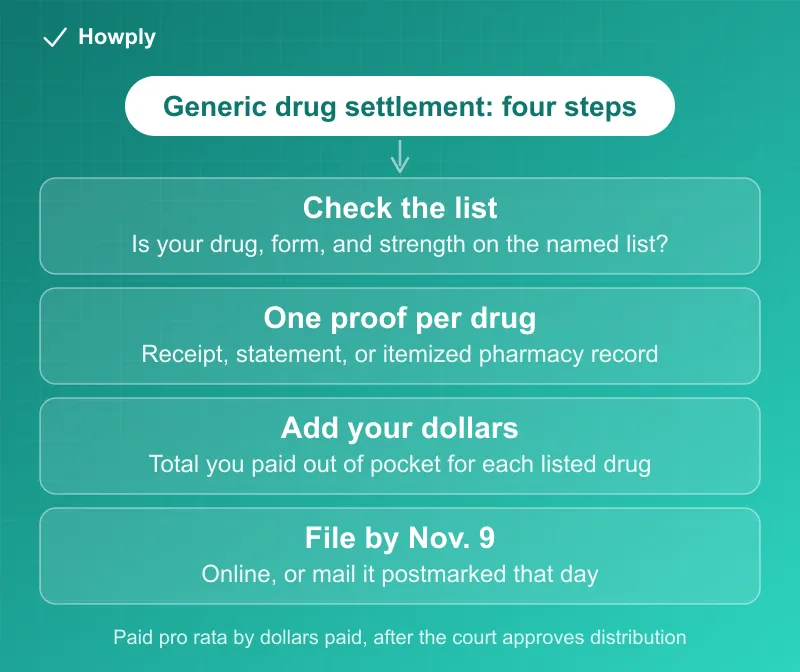
If you bought covered generic drugs between 2009 and 2019, check the named drug list, find one receipt, statement, or itemized pharmacy record for each drug, total the dollars you paid yourself, and file by November 9, 2026, online or by mail postmarked that day. Expect a pro rata share, not a flat payment, and expect it to come well after the deadline. File only on the official site or with the administrator, since no firm is needed, and look at the separate state program, which has until March 8, 2027.
Class definition, exclusions, proof rules, dispute steps, mailing address, and deadline are quoted from the official end-payer settlement website, its consumer claim instructions, and the Consumer Claim Form; the allocation method and timing from the Proposed Plan of Allocation for the Sandoz settlement; the claims process from the court’s June 10, 2026 order; and the state program from the California Attorney General’s September 24, 2026 release. All were read on October 3, 2026. The ten-cents-per-dollar example is our illustration and not a forecast. Settlement terms can change, and the settlement site is the authority on your claim. This is general information, not legal advice.
Official sources
- In re Generic Pharmaceuticals Antitrust Litigation, end-payer settlements: official website (home page)
- End-payer settlements: instructions for submitting your consumer claim form
- End-payer settlements: Consumer Claim Form for the Sandoz and Sun/Taro Settlements (PDF)
- End-payer settlements: Drug List for Claim Form, July 30, 2026 (PDF)
- End-payer settlements: Sandoz settlement class page
- End-payer settlements: Sun/Taro settlement class page
- End-payer settlements: court documents (plan of allocation, final approval order, claims process order)
- Proposed Plan of Allocation for the EPP Sandoz Settlement (PDF)
- Order regarding notices, notice plan, claim forms, and claims administrator, June 10, 2026 (PDF)
- California Attorney General: Attorney General Bonta Urges Consumers to Claim Compensation for Inflated Generic Drug Prices (September 24, 2026)