Canceled Your Subscription but Still Getting Charged? How to Stop It
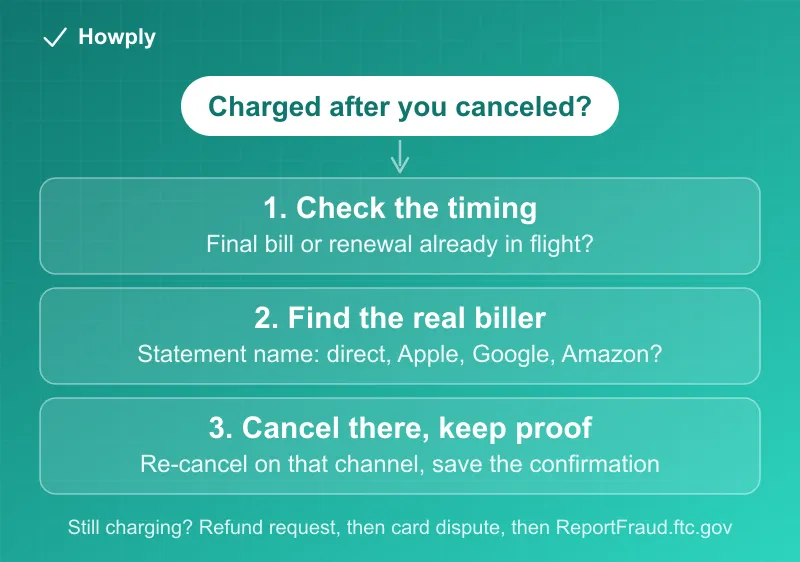
A surprise charge after canceling usually means a final bill in flight or a second biller you missed. The checklist to find it, stop it, and get the money back.
You canceled. You saw the confirmation screen. And the charge landed anyway. Before assuming the worst, know that this almost always has one of three causes: a final bill that was already in flight, a cancellation made on the wrong billing channel, or a company that genuinely will not stop. The first two are ten-minute fixes. The third has a federal dispute process behind it, and the FTC’s own guidance lays out exactly how to use it.
The quick answer
- Check the timing first. A charge dated before your cancellation, or a renewal that processed the same day you canceled, is usually the final scheduled bill, not a new one
- Find who actually bills you. The name on your card statement tells you: the company directly, Apple, Google Play, Amazon, or a carrier. A cancellation only counts on the channel that charges the card
- Deleting the app never stops billing. The subscription lives in a billing account, not on your phone
- Re-cancel on the right channel and keep proof. The FTC says to keep a copy of your cancellation request and notes of every conversation
- If charges continue, dispute them with your card company. For credit cards, your dispute letter must reach the issuer within 60 days of the first bill with the error
- Still stuck? Report the company at ReportFraud.ftc.gov and to your state attorney general
Key facts at a glance
| Question | Answer |
|---|---|
| Charge appeared right after I canceled | Often the already-scheduled final bill; compare the charge date to your cancellation date |
| Who do I actually cancel with? | Whoever charges the card: the company, Apple, Google Play, Amazon, or your carrier |
| Does deleting the app cancel it? | No. Billing continues until you cancel in the account that owns the payment |
| The company will not stop charging | Dispute the charge with your credit or debit card company, per FTC guidance |
| Credit card dispute deadline | Your letter must reach the issuer within 60 days of the first bill containing the error |
| What the issuer must then do | Acknowledge your dispute in writing within 30 days, resolve it within 90 days |
| Charges you never authorized | Federal law caps your liability at $50 |
Step 1: rule out the boring explanations
Most “still getting charged” cases are a calendar problem, not a billing problem. Check three things against your cancellation date:
- The final bill was already in flight. If you canceled a day or two before the renewal date, the charge may have already been submitted to your card. Most subscriptions also run until the end of the period you paid for, so a cancellation today often coexists with a charge from last week
- The price changed, not the subscription. A renewal that costs more than you remember is often a promotional rate expiring. The FTC specifically flags this pattern: the auto-renewal is the same subscription, billed at the standard price once the promo ends
- It is a hold, not a charge. Pending authorizations can appear and vanish without posting
If the charge predates your cancellation or matches the documented final bill, nothing is broken. Set a reminder to check the next statement, and only escalate if a fresh charge appears.
Step 2: find out who really bills you
Read the merchant name on your card statement. This single line answers most mysteries, because a subscription can be billed by the company itself or by a middleman: Apple, Google Play, Amazon, or a mobile carrier. Canceling on the company’s website does nothing if Apple owns the billing, and vice versa. Our cancellation guides, like the Netflix walkthrough, split into exactly these paths for that reason.
Two more classic culprits while you are looking:
- A duplicate account. Two email addresses can mean two live subscriptions, and you canceled only one
- A family or group plan. On shared plans, only the plan manager can stop the billing, so your member-level cancellation may not touch the charge
Step 3: cancel on that channel and keep everything
Once you know the real biller, cancel there, following the company’s own instructions if it has them. Then build your paper trail, which is straight from the FTC playbook: keep a copy of the cancellation request, note the date, and save any confirmation number or email. Screenshots count. For contract businesses that take cancellations by mail, like many gyms, send it certified with a return receipt, a route our gym membership guide covers in detail.
Step 4: ask for the money back before you dispute
Contact the company’s support with your proof and ask them to refund every charge made after your cancellation date. Many companies simply do it. It is worth quoting the standard the FTC states plainly: businesses must make canceling simple for you, it is the law. A company that keeps billing after a documented cancellation knows it is on the wrong side of that line.
Step 5: the card dispute, done properly
If the company will not stop or will not refund, the FTC’s dispute guidance is your script. Start the dispute online or by phone with your card company, then protect your rights by following up in writing to the address listed for billing disputes, ideally by certified mail with a return receipt.
For credit cards, federal law then puts hard numbers on the process:
- Your letter must reach the issuer within 60 days after the first bill containing the error was sent to you
- The issuer must acknowledge your complaint in writing within 30 days and resolve the dispute within 90 days
- You can withhold payment on the disputed amount while the investigation runs, though you must keep paying the rest of the bill
- The issuer cannot close your account, threaten your credit rating, or report you as delinquent without noting that you dispute the amount
- For charges you never authorized at all, your maximum liability is $50
Paid by debit card? Dispute it with your bank the same way, and move quickly, since debit protections run on different rules and tighter clocks. Outside the US, the dispute route through your bank or card network exists too, just under different deadlines.
When to report it
If you tried to cancel and the company would not let you, or it keeps charging a canceled account, the FTC asks you to report it at ReportFraud.ftc.gov and to your state attorney general. Reports build the cases that end these billing practices, and filing one takes a few minutes.
Bottom line
Timing explains half of these charges, and the wrong biller explains most of the rest, so check the dates and the statement name before anything else. Then the ladder is short: re-cancel on the channel that owns the payment, keep proof, ask for a refund, dispute with your card company inside the 60-day window, and report a company that still will not quit. Every step up the ladder works better with the paper trail from the step below it.
Process and deadlines verified against FTC consumer guidance. If the FTC updates its guidance, this guide will be updated with the revision noted.