How to Dispute a Subscription Charge with Your Bank (and When Not To)
Federal law gives you 60 days, a written-notice rule, and an interest-free wait. But disputing a live subscription can cost the account. The rules, decoded.
Nearly every guide on this site ends the same way: ask the biller first, and keep the bank as the backstop. This is the guide to the backstop. A credit card dispute is not a customer service request, it is a legal process under the Fair Credit Billing Act with real deadlines on both sides: you get 60 days to file properly, and the card company gets 30 days to acknowledge and 90 to resolve. Used on the right charge it is close to unbeatable. Used on the wrong one, it is slower than the refund desk and can take your account down with it.
The quick answer
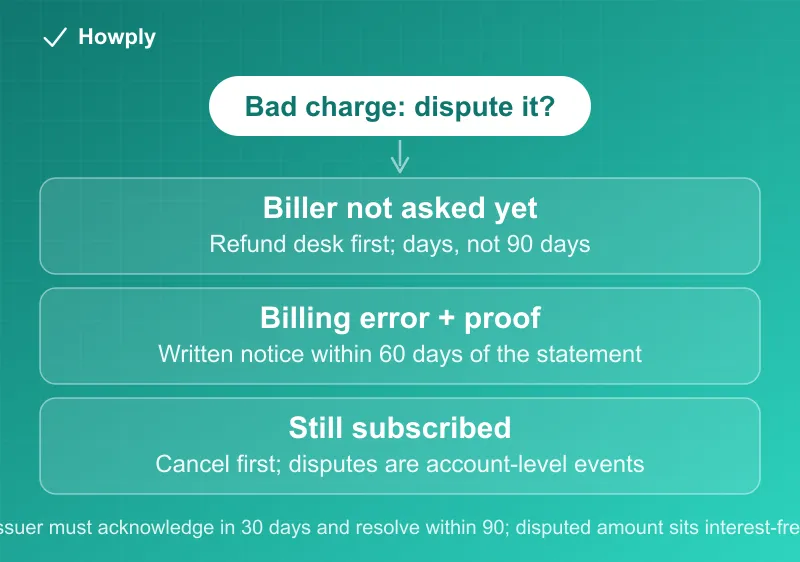
- Try the biller first, always. A platform refund takes days; a dispute takes up to 90. The dispute is for when the biller refuses or stalls on a charge you have a right to reverse
- Your deadline: 60 days. Per the FTC, your written dispute must reach the issuer “within 60 days after the first bill with the error was sent to you”
- Call AND write. The CFPB is explicit that calling is not enough: “to protect your rights you must also send a written billing error notice”
- Their deadlines: 30 and 90 days. Written acknowledgment within 30 days of your complaint, resolution within 90
- You do not pay the disputed amount while they investigate, no interest accrues on it, and paying the rest of the bill preserves your grace period
- Cancel the subscription before you dispute it. A dispute against a merchant you still subscribe to invites both a re-bill next cycle and account-level fallout
Key facts at a glance
| Question | Answer |
|---|---|
| The law | Fair Credit Billing Act (credit cards) |
| Your filing window | Written notice within 60 days of the statement with the error |
| Phone call enough? | No; rights attach to the written notice |
| Issuer must acknowledge | Within 30 days, in writing |
| Issuer must resolve | Within 90 days of your complaint |
| Disputed amount meanwhile | Not payable, accrues no interest |
| If they rule against you | They must explain why in writing |
| Already paid the charge | You can still dispute it |
| Debit cards | Different law, different timelines; report even faster |
What a dispute is actually for
The FCBA covers billing errors: charges you never authorized, amounts that are wrong, and charges for things that were canceled or never delivered. That maps cleanly onto the subscription failure modes in this series: the renewal that billed after you canceled, the genuine duplicate charge the biller will not fix, the trial that converted after you canceled in time with proof.
What it does not cover is regret. “I forgot to cancel” and “I did not use it” are not billing errors, and disputes filed on them tend to lose, because the merchant answers the dispute with your signup records. One more boundary from the CFPB: goods or services that are defective rather than wrongly billed go through a different claims process, so a broken product is an argument for the refund desk, not usually the billing-error form.
The clock and the paperwork
Three deadlines run the process, all from official sources:
- Yours, 60 days. The clock starts when the statement carrying the error is sent. Call the issuer right away, but per the CFPB, the phone call alone does not protect you: send the written billing error notice to the issuer’s billing-inquiries address (most issuers also accept it through the dispute flow in their app, but keep a copy and a date)
- Theirs, 30 days: written confirmation that they received your dispute
- Theirs, 90 days: a resolution. If they side with you, the charge and its interest are removed. If they side with the merchant, they owe you a written explanation, and you can still pursue the biller separately
While the investigation runs, the disputed amount is untouchable: you do not have to pay it, no interest builds on it, and if you pay everything else on the bill, your grace period on new purchases survives. Include the evidence that decides subscription cases: the cancellation confirmation email, the double-charge statement lines, the refund-request denial. Every guide in this series tells you to keep those receipts; this is where they get used.
When not to dispute
- When you have not asked the biller yet. Apple, Google, Amazon, and the rest resolve legitimate cases in days through their own flows. The dispute is the appeal, not the first filing
- When you are still subscribed. Cancel first. An active subscription bills again next cycle regardless of the dispute’s outcome, and platforms treat disputes as an account-level event: assume the account and its purchases could be frozen while it plays out, and weigh what is attached to that account (a game library, a decade of purchases) against one month’s fee
- When the amount is small and the account is big. Winning $12 back on the card that anchors your digital life is sometimes a bad trade. The refund desk costs nothing to try twice
- When it was your mistake. Save the silver bullet for actual billing errors, so it is available, and credible, when one happens
Debit cards are a different animal
Everything above is credit card law. Debit card disputes run under a different statute with its own reporting windows, and the money is already gone from your account while the process runs, which makes speed matter even more. If a bad subscription charge hits a debit card, contact your bank immediately, and consider moving recurring subscriptions to a credit card precisely because the dispute protections above are stronger there.
Bottom line
The order of operations for any bad subscription charge: cancel the subscription, request the refund from whoever billed you, and only then escalate to a written dispute with your card issuer, inside 60 days, with your evidence attached. From there the law does the pacing: 30 days to acknowledge, 90 to resolve, and the disputed amount costs you nothing while you wait. It is the strongest tool in this series, which is exactly why it should be the last one you reach for.
Deadlines, written-notice requirements, and investigation protections verified against the CFPB and FTC pages linked above as of August 11, 2026. Card issuer flows vary; the official pages are the source of truth. This is general information, not legal advice.