How Apple Upgrade Works: Klarna Lease Costs, the 14-Day Return, Early Exit
Apple's lease program: you never own the phone, leaving after 14 days means paying every remaining month, and Chase, Citi, and Amex cards are not accepted. The FAQ, quoted.
The cheapest monthly number on Apple’s iPhone 18 Pro page is not the installment plan. It is Apple Upgrade, the lease that starts at $34.99 a month, and its page opens with the phrase that explains the price: “Love it. Lease it. Upgrade it.” Apple’s own footnote is more precise: “This offer is for a consumer lease, not a purchase or loan.” That single sentence changes every rule that follows. You never own the device, a change of mind after 14 days costs every remaining month, a damaged return carries a fee set by Klarna, and several major credit cards cannot be used to pay. With pre-orders open and the program replacing the old iPhone Upgrade Program, here is what the page and its FAQ say, read on September 13, 2026.
The quick answer
- It is a lease from Klarna, not a loan from Apple. Klarna provides the lease and decides eligibility and credit approval, with a final approval at checkout
- Terms: “a 12 or 24 month lease for iPhone and Apple Watch,” “a 24 or 36 month lease for iPad and Mac.” No down payment is allowed: “No, you cannot add a down payment”
- What it costs for the new phones: iPhone 18 Pro from $34.99 a month for 24 months or $49.99 a month for 12 months; iPhone Duo from $57.99 a month for 24 months or $82.99 a month for 12 months; iPhone Air from $31.99; iPhone 17 from $25.99; iPhone 17e from $19.99, all on 24 months
- You do not own it at the end. “No, you do not. You must return your device in good working condition at the end of your lease term”
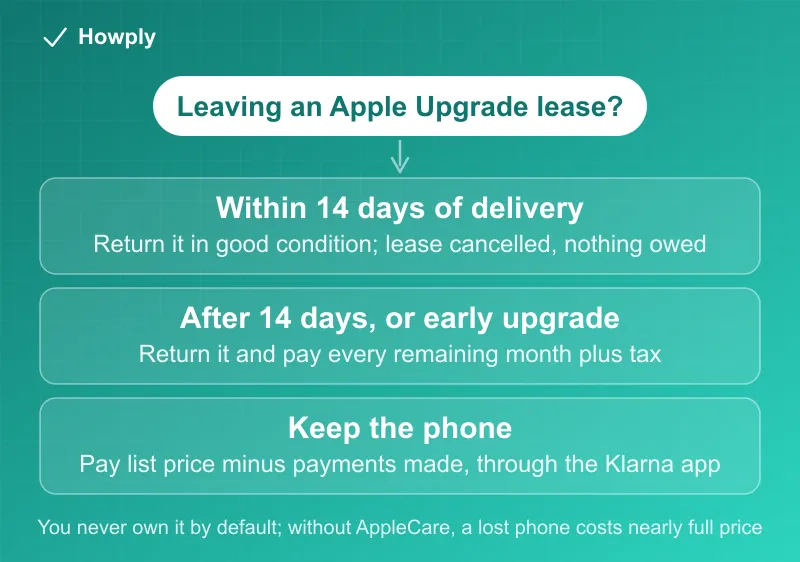
- Changing your mind has a 14-day window, counted from delivery: return the device “in good working condition” and “your lease will be cancelled.” After that, you must return the device in good working condition and still pay every remaining monthly payment
- Leaving early or upgrading early costs the balance: “the full amount of your remaining lease payments plus applicable taxes”
- Payment restrictions: Klarna does not accept “AMEX and UnionPay” networks or the issuers “Chase, Capital One, and Citibank”; “Apple Pay and PayPal are not accepted for Apple Upgrade”
Key facts at a glance
| Question | What Apple’s page says |
|---|---|
| Who is the lender? | Klarna Inc.; approval “is based on creditworthiness” |
| When is the first payment? | ”Approximately 30 days after device is shipped or available for pickup” |
| Are there fees? | ”No fees associated with your monthly lease payment,” but a damage fee applies if the device is not returned in good condition |
| Can I lease an iPhone without a carrier? | No: “you’ll need to connect to AT&T, T-Mobile, or Verizon,” and “you cannot use a prepaid carrier plan.” iPad, Mac, and Watch need no carrier |
| Is AppleCare included? | ”No, AppleCare coverage is not included,” and you have “up to 60 days after you enroll” to add it |
| What if I return it after 14 days? | Return it and pay every unpaid monthly payment, plus taxes, through the end of the initial term |
| What if I upgrade at 21 months of 24? | ”You’ll pay the remaining three monthly payments plus applicable taxes” |
| Can I buy it outright? | Yes: pay the list price as of signing, plus taxes, minus payments already made and any remaining trade-in credit, in the Klarna app |
| Will I pay more than the device costs? | ”If you return your device in good working condition, you will not pay more than the full price of the device” |
| Lost or stolen without AppleCare? | Pay “the full price of the device at lease signing less the sum of lease payments you’ve already made” |
| Order not picked up in 7 days? | ”Your lease will be cancelled, and any associated charges would be refunded” |
| Trade-in? | Applied “by Klarna across your payments for the length of your initial lease term”; “you cannot trade-in a device when you upgrade” |
What the monthly number actually buys
The lease footnote gives a worked example that anchors the math: an iPhone 18 Pro 256GB with a $1,199 purchase price leases for a typical $34.99 a month on a 24-month term, or $49.99 on a 12-month term, before taxes and any trade-in credit. Twenty-four payments of $34.99 come to $839.76, which is why Apple can promise that “if you return your device in good working condition, you will not pay more than the full price of the device.” The difference between $839.76 and $1,199 is the phone’s residual value, and it stays with Klarna because the phone goes back.
That is the trade. Installments spread the full $1,199 and leave you with a phone; the lease charges about 70 percent over two years and leaves you with nothing to sell or trade. The FAQ spells out the ownership answer without hedging: “Do I own my device at the end of my lease term? No, you do not.”
Pricing is per device and per term. The 12-month options run higher per month because the residual is lower: $49.99 for the 18 Pro, $82.99 for the Duo. Apple lists the lease on the same product pages as the installment and full-price options, which is why the three numbers are easy to confuse at checkout; the launch prices for all three are in our sister site’s pre-order guide.
The three exits, and what each costs
Apple’s FAQ answers “how much will it cost to upgrade, leave the program, or buy the leased device” in three parts, and the arithmetic is the same in all three: the remaining months are owed.
Upgrade. Upgrading at the end of the term costs nothing extra. Upgrading early means paying every remaining monthly payment plus tax first; Apple’s own example is an upgrade after 21 months of a 24-month lease, which costs the last three payments. Upgrading also means “entering into a new lease,” which is “subject to eligibility and credit approval” again.
Leave. Return the device at the end of the term and leaving the program costs nothing. End the lease earlier and you owe every remaining monthly payment plus applicable taxes.
Buy. To keep the device, you pay in the Klarna app the list price (plus taxes) that applied when you signed, minus the lease payments you have already made and any remaining trade-in credit. At 24 months on the 18 Pro example, that is $1,199 minus $839.76 paid, about $359 plus tax, which lands you at full price for a two-year-old phone.
In every case the device must come back “in good working condition to avoid any damage fees.” The return itself uses “the prepaid return kit we provide,” or a drop-off “at an Apple Store.”
The 14-day change-of-mind rule
This is the clause to read before the phone arrives. “If you change your mind after you enroll in Apple Upgrade, you have 14 days after receiving your device to return your device back to us in good working condition. After we receive your device, your lease will be cancelled.” That mirrors Apple’s normal return window and costs nothing beyond returning the device intact.
Day 15 is a different contract: after 14 days you must return the device in good working condition and still pay every unpaid monthly payment, plus taxes, through the end of the initial term. There is no partial credit for early return. A 24-month lease returned in month three is billed for 21 months, and Apple’s page does not describe any hardship exception.
A separate rule covers an order that never starts: “If you don’t pick up your Apple Upgrade device within 7 days of placing your order, your lease will be cancelled, and any associated charges would be refunded.”
Damage, loss, and why AppleCare is the quiet second subscription
The lease price includes no protection, and the page repeats that from two angles. “AppleCare coverage is not included with your Apple Upgrade lease. If you choose to purchase AppleCare protection, it will be billed separately from your lease by Apple.” And the damage consequence without it: “If you don’t have AppleCare coverage and your device is not returned in good working condition, Klarna will charge you a one-time damage fee. You can repair your device before you return it to avoid this fee.” The fee amount is not published on the page.
Loss is the expensive case. “If you don’t have AppleCare+ Theft and Loss coverage… and your device is stolen or lost, you’ll need to pay the full price of the device at lease signing less the sum of lease payments you’ve already made, plus applicable taxes, to purchase the device.” Lose an 18 Pro in month two and you owe roughly $1,129 for a phone you no longer have. Worse, inaction compounds it: “If you take no action, Klarna will continue to charge you your monthly lease payment through the extension period, and then you will be charged to purchase the device through Klarna.”
Which is why Apple’s advice reads the way it does: “Add AppleCare coverage when you enroll, and your return will be much easier.” The window is “up to 60 days after you enroll,” or you “can add your leased device to your AppleCare One subscription.” What each AppleCare tier costs and cancels, including the new Family plan launching September 14, is in our AppleCare One Family guide.
The trade-in interaction
Apple Trade In works differently under a lease, and the difference is in who applies the credit. You can trade in an eligible device when you first enroll, and instead of a lump sum, Klarna spreads the credit across the payments of your initial lease term to lower each monthly bill. So an $885 credit on a 24-month lease shows up as about $36.88 off each month.
Two consequences follow. The credit is conditional on inspection, as with any Apple trade-in: if the old device never arrives or is not in good working condition, Klarna adjusts the monthly payment to the revised value. And it is a one-time benefit: the credit applies only to the initial lease term, and there is no trade-in when you upgrade. The inspection rules, revised offers, and the 14-day trade-in clock are in our Apple Trade In guide.
Who cannot pay, and who cannot enroll
The payment restrictions are unusual enough to check before pre-ordering. Apple says “You can use all debit cards and select major credit cards for your Klarna payments.” But “some card networks, like AMEX and UnionPay” and “some card issuers, like Chase, Capital One, and Citibank” are “not accepted by Klarna.” Apple takes those cards for AppleCare and accessories, but “Apple Pay and PayPal are not accepted for Apple Upgrade.” Payments are managed “through the Klarna app,” not through Apple, so an unfamiliar Klarna line on a statement is this program; our unrecognized charge guide covers the Apple-side charges that sit alongside it.
Eligibility, from the footnote: a U.S. resident (territories excluded), at least 18 or your state’s legal age, with an accepted credit or debit card and an Apple ID. The program “is not available on refurbished devices” or through employee, corporate, business, government, education, or military purchase programs. And the lease is a credit product: “Lease approval is subject to eligibility and is based on creditworthiness.”
For anyone still on the old iPhone Upgrade Program, Apple’s page states plainly that “the program is coming to an end,” with a sign-in path to see the options for moving over.
Bottom line
Apple Upgrade turns an iPhone into a two-year rental at roughly 70 percent of its price, with Klarna as the lender, no down payment allowed, and no ownership at the end unless you pay the difference. It is cheap month to month and expensive to leave: after the 14-day return window, every remaining payment is owed on exit, upgrade, or early return, and a lost phone without AppleCare costs nearly its full price. Before enrolling, confirm the card you plan to use is one Klarna accepts, decide on AppleCare within 60 days, and treat the trade-in as a monthly discount that can be revised after inspection.
All quotes from Apple’s Apple Upgrade page, its FAQ, and its lease footnotes, read on September 13, 2026, with launch pricing from Apple’s September 9 press release, and rechecked as of October 18, 2026, when every lease price and term still matched and only Apple’s wording of the card note had changed. Lease terms are set at checkout by Klarna; the agreement you sign is the one that applies.