Amazon Prime Settlement Refunds: How the New $200 Automatic Payments Work
The FTC raised the Prime refund cap from $51 to $200 and dropped the claim forms. Who is newly eligible on October 1, who may get $149 more, and the scams.
The Amazon Prime settlement changed on September 17, 2026. The FTC announced that a federal court approved a revised order that raises the maximum refund from $51 to $200, opens the program to people who used Prime far more than the original cutoff allowed, and ends the claim forms entirely. Here is what the FTC’s press release and its program page say, in their own words, about who gets paid starting October 1, who might receive $149 more in 2027, and what you need to do, which for most people is nothing except accept the payment before it expires.
The quick answer
- The cap is now $200. The FTC’s program page states a “maximum total payment of $200” and notes that “earlier payments under the order were capped at $51 per eligible customer”
- No claim form anymore. The page reads: “You do not have to file a claim, respond to a notice, or complete any forms. Amazon will send automatic payments to eligible customers”
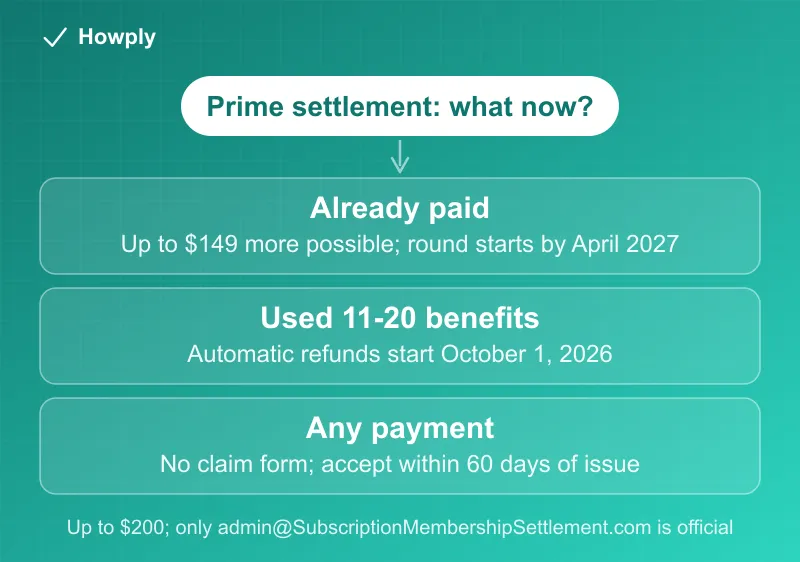
- Newly eligible, paid from October 1, 2026: people who “used between 11 and 20 Prime benefits during a one-year period,” by Venmo, PayPal, or mailed check
- A possible extra $149 for people already paid, but only on a condition: “If consumer-accepted payments do not reach the required threshold by February 2027.” That round “will start by April 2027”
- Payments expire. “Payments expire 60 days after the issue date. Please accept your payment on time”
- Scam armor: “The FTC is not contacting people about refunds in the Amazon matter,” and “no one from Amazon will ever ask you for money to get a refund”
Key facts at a glance
| Question | Answer |
|---|---|
| Maximum refund | $200 total of Prime subscription fees (was $51) |
| Claim form | None. All future payments are automatic |
| Newly eligible group | Used 11 to 20 Prime benefits in a one-year period; automatic refunds start October 1, 2026 |
| Extra payment for earlier recipients | Up to $149 more, only if accepted payments miss a threshold by February 2027; round starts by April 2027 |
| Eligibility window | June 23, 2019 to June 23, 2025 |
| Usage rule | No more than 20 Prime benefits in any 12-month period after enrollment |
| Payment methods | Mailed check, PayPal, or Venmo |
| Time to accept | 60 days from the issue date |
| Final timeline | ”If you are eligible, you will get your refund by April 2027” |
| Paid so far | More than $845 million as of September 2026, out of up to $1.5 billion |
| Official help | admin@SubscriptionMembershipSettlement.com or 1-888-999-8094 |
What changed on September 17
The FTC’s announcement says that “a federal court approved a joint motion filed by the FTC and Amazon, approving measures to accelerate and expand future redress payments to consumers.” It then lists three changes in one sentence: “more consumers will now qualify for refunds from Amazon, the maximum payment cap has been raised from $51 to $200 total, and all future payments will be distributed automatically, eliminating the need for consumers to submit claims or additional paperwork to Amazon.”
The background numbers explain why. The settlement requires Amazon to pay “up to $1.5 billion in redress to consumers,” and the FTC reports that “as of September 2026, Amazon has issued more than $845 million.” A large share of the fund had not reached anyone, and the revised order is the mechanism for moving it.
The two tracks, side by side
The revised order creates two different groups with two different dates, and most coverage blends them together. They are separate.
| Newly eligible group | People already paid | |
|---|---|---|
| Who | Used “between 11 and 20 Prime benefits during a one-year period” and “were not included in the earlier redress payment phases" | "Consumers who previously received refunds under the settlement” and accepted them |
| What | ”Automatic refunds” of Prime subscription fees | ”An additional $149, for a total of $200” |
| When | ”Starting on October 1, 2026" | "This last round of supplemental payments will start by April 2027” |
| Condition | None stated beyond the three eligibility rules | Only “if consumer-accepted payments do not reach the required threshold by February 2027” |
| What you file | Nothing | Nothing |
Two cautions follow from the FTC’s own wording:
- The extra $149 is conditional, not promised. It depends on how much money other people accept by February 2027, and the press release does not publish the threshold. The program page is equally careful: “Amazon may issue additional payments of up to $149 per eligible customer.” If you were paid last winter, do not budget for a second payment until one arrives
- The FTC does not state a per-person amount for the October payments. It states only the ceiling: refunds of Prime subscription fees “with a maximum total payment of $200.” What you receive depends on the Prime fees you paid
The three eligibility rules, as revised
All three must be true, per the FTC’s program page:
- You are an Amazon Prime customer in the United States
- Between June 23, 2019 and June 23, 2025, you either signed up through a “challenged enrollment flow” (the “universal Prime decision page, shipping selection page, single page checkout, or the Prime Video enrollment flow”) or you “tried to cancel through the online cancellation flow but were unable to do so”
- You “used no more than 20 Amazon Prime Benefits (including Prime Music or Prime Video products offered for free to Prime subscribers) in any 12-month period following Amazon Prime enrollment”
Rule 3 is the one that moved. The press release describes the original order as covering people “who used fewer than 10 Prime benefits during a one-year period,” and when this guide was first published in August 2026 the FTC’s page put the limit at three benefits. At 20, the settlement now reaches people who used Prime a little more than once a month, not only people who never touched it. If you ruled yourself out earlier this year because you watched a few shows or ordered a handful of packages, the rule that excluded you no longer exists.
You do not need to work out rule 2 yourself. Amazon identifies eligible accounts, and the FTC notes that “Amazon is responsible for administering the redress program.”
If you received a claim notice earlier in 2026
From January 2026, Amazon sent claim notices by mail and email to some eligible customers, and earlier versions of this guide told you to file through that notice. The FTC’s page no longer describes a claims process at all. It now says: “No action is needed to receive a refund.”
The FTC has not published separate instructions for people who already filed a claim or who still hold an unanswered notice. If that is you, the official route for a status question is the administrator, not the FTC: admin@SubscriptionMembershipSettlement.com, 1-888-999-8094, or SubscriptionMembershipSettlement.com. The FTC’s January consumer alert, which still mentions checks “for up to $51” and claim instructions, was written before the revised order and has not been updated.
What to do now
- Watch for the payment, not for a form. It arrives as a mailed check or as a PayPal or Venmo payment. There is nothing to submit first
- Accept it within 60 days. The FTC’s page is blunt: “Payments expire 60 days after the issue date.” A PayPal or Venmo payment you ignore, or a check you leave in a drawer, can lapse
- Expect it by April 2027 at the latest. The page states, “If you are eligible, you will get your refund by April 2027.” The newly eligible group starts on October 1, 2026, but the FTC gives no per-person mailing date
- Take questions to the administrator only, using the address and phone number above. The FTC does not handle individual payments
The scam version of this story
A refund that just quadrupled is a fresh hook for impersonators, and the FTC repeats its warnings on both pages:
- “The FTC is not contacting people about refunds in the Amazon matter. If someone contacts you and claims to be with the FTC, it is likely a scam.” Report it at ReportFraud.ftc.gov
- Nobody legitimate charges a fee. “Don’t pay anyone who promises you a refund in exchange for a fee. And don’t give personal information to anyone who contacts you promising a refund”
- Nobody can speed it up. “Only scammers say they can get you special access or a guaranteed refund”
- There is no form to fill in, so any message that asks you to “file your claim for $200” through a link is false on its face. The real program now requires no claim at all
Note what the official site is called. As the FTC’s consumer alert points out, the URL “doesn’t say ‘Amazon’ or ‘refund’ in it. It’s SubscriptionMembershipSettlement.com.” If a message pushes you toward any other site, close it and type the official address yourself. The same log-in-directly habit from our free trial charges guide applies here.
If you are still paying for Prime you do not use
The settlement covers the past; the subscription itself is the ongoing cost. If a Prime charge appeared that you never remembered agreeing to, our canceled but still being charged guide covers the general problem, canceling takes a few minutes through the steps in our Amazon Prime cancellation guide, and if a refund for a recent charge is the goal, Amazon’s own refund paths come first.
Bottom line
The cap is $200, the usage limit is 20 benefits, and the claim form is gone. If you used Prime lightly between mid-2019 and mid-2025 and were never paid, automatic refunds for the newly eligible group begin October 1, 2026. If you were already paid, a further payment of up to $149 is possible in a round starting by April 2027, but only if the fund is still short in February. Either way, the one thing that can cost you money is letting a payment sit for more than 60 days, or answering a call about it. Prime’s current prices and discount plans are in our Amazon Prime cost guide.
Facts verified against the FTC’s September 17, 2026 press release and its Amazon Refunds program page on September 19, 2026, with every quotation taken from those pages. This guide was first published on August 15, 2026 under the original order ($51 cap, claim notices) and was rewritten when the revised order was announced. It will be updated when the October payments are confirmed as issued and when the FTC says whether the February 2027 threshold was met. This is general information, not legal advice.