How Allianz Ticket Protection Refunds Work, and When It Pays Nothing
The box at Ticketmaster checkout covers you missing the show, not the show being canceled. Covered reasons, the 15-day refund on the plan, and how to claim.
The checkbox appears late in a Ticketmaster order, after you have already accepted the fees, and it asks for a few dollars more to protect a purchase you cannot otherwise refund. Most people either take it reflexively or skip it without knowing what it does. The product is Allianz Ticket Protection, sold as Event Ticket Protector and underwritten by Jefferson Insurance Company, and its rules are narrower than the checkout screen suggests in one direction and more generous in another. It does not pay when the concert is canceled. It does pay when your car breaks down on the way, and it can be refunded outright for 15 days if you change your mind about buying it. Here is what the official pages say, read on September 9, 2026.
The quick answer
- What it pays: “100% of your Ticketmaster or Live Nation ticket costs back, including taxes and fees,” if you or someone in your group cannot attend for a covered reason. Ticketmaster’s help page adds the limit: “up to your plan limit,” and its insurance page includes “convenience fees and shipping charges along with other eligible event-related items that have been added to your order, such as parking”
- What it does not pay: anything for an event the venue or promoter cancels. That refund comes from the ticket seller instead, and the correct move is to cancel the insurance plan for a full refund of what you paid for it
- Covered reasons Allianz lists by name: “Covered Illness or Injury,” “Job Loss,” “Traffic Accident,” “Mechanical Breakdown,” “Childbirth,” “Urgent Home Repair.” Ticketmaster’s page adds jury duty. The full list lives in your Certificate of Insurance, and “Covered reasons, limits, and exclusions vary by plan and state of residence”
- Change of mind is not covered, and pre-existing conditions are called out as an exclusion: “Terms, conditions, and exclusions apply, including for pre-existing conditions”
- You can get the premium back: “you have 15 days (or more, depending on your state of residence) to request a full refund, provided you haven’t started your event or initiated a claim”
- Rescheduled show you still plan to attend: update the plan to the new date “within 770 days of your original purchase”
- Where everything happens: eventticketprotection.com/tm, using your email or policy number, or by phone
Key facts at a glance
| Situation | What the official pages say |
|---|---|
| You get sick and miss the show | Covered reason; claim reimburses the ticket price, taxes and fees up to the plan limit |
| Your car breaks down on the way | ”Mechanical Breakdown” is listed as a covered situation |
| You lose your job before the show | ”Job Loss” is listed as a covered situation |
| You simply decide not to go | Not covered; insurance pays only for covered reasons |
| The promoter cancels the event | Insurance pays nothing. Ticketmaster: “you can cancel your plan for a full refund of the plan’s cost” |
| The event is rescheduled and you will attend | Update the plan to the new date “within 770 days of your original purchase” |
| The event is rescheduled and you cannot attend | Cancel the plan for a full refund of the plan cost |
| You regret buying the insurance | Full refund of the premium within 15 days, “or more, depending on your state of residence,” if the event has not started and no claim was filed |
| After that window | ”Premiums are nonrefundable after this period” |
| Who actually insures it | ”Insurance benefits are underwritten by Jefferson Insurance Company,” administered by AGA Service Company, “only available to U.S. residents” |
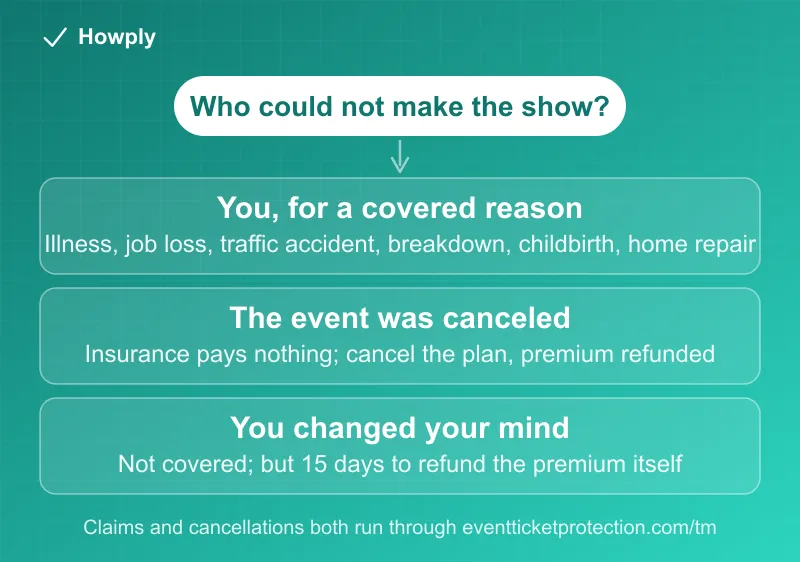
The distinction that decides most claims
Read the two sentences together and the product’s shape is obvious. Allianz’s program site says protection applies “if you or a member of your group can’t go due to a covered situation.” Ticketmaster’s insurance page says that if the event “has been canceled or if you cannot make the rescheduled event date, you can cancel your plan for a full refund of the plan’s cost.”
So the policy insures your ability to attend, not the event’s ability to happen. When a promoter cancels, the ticket refund is the seller’s job, and the insurance simply unwinds. Fans who buy the plan expecting it to cover a canceled tour are buying a second refund that does not exist, and fans who forget they bought it leave the premium on the table when a show is scrapped. If your canceled show was bought on a resale marketplace rather than from Ticketmaster directly, the refund rules differ by platform, and they are compared in our sister site’s canceled show refund guide.
What counts as a covered reason
Allianz’s site names six situations outright: “Covered Illness or Injury,” “Job Loss,” “Traffic Accident,” “Mechanical Breakdown,” “Childbirth,” “Urgent Home Repair.” Ticketmaster’s help article phrases its own short list as “a covered medical issue, traffic accident, jury duty, or other covered reason.” Both stop short of a complete list on purpose, and both point to the same document: “Please review your Certificate of Insurance/Policy for more details. Covered reasons, limits, and exclusions vary by plan and state of residence.”
That state-by-state variation is the part worth taking literally. The certificate emailed at purchase is the only text that governs your claim; a covered reason that a friend used successfully in another state may not appear in yours. Two exclusions are stated plainly enough on the public pages to plan around: change of mind is never a covered reason, and pre-existing conditions are specifically flagged.
The plan also bundles a non-insurance service, Viewer Advantage, described as “a 24-hour assistance service that can help with event parking information, hotel reservations, transportation arrangements, and other experience enhancements,” reachable at (800) 424-3396. It is a concierge line, not a claims line, and it has no bearing on whether a claim is paid.
Getting the premium itself back
This is the least advertised useful fact in the product. Both Ticketmaster and Allianz describe a free look period: “You have 15 days to cancel your plan and receive a full refund of the plan price,” extended in some states, and void once “your event has started, you’ve filed a claim, or the policy has ended.” Allianz’s wording adds the same three conditions and the flat consequence: “Premiums are nonrefundable after this period.”
Two practical uses. If the insurance was an impulse click at checkout, you have two weeks to undo it at no cost. And if the event is canceled or rescheduled beyond your reach, the premium refund is separate from, and on top of, whatever the ticket seller returns for the ticket itself. Ticketmaster’s insurance page directs cancellations to a phone number, (800) 424-2296, while its help center and Allianz both list (800) 424-3396; that page also still carries a COVID-era banner, so treat the number printed on your own policy documents as the current one, and use the management portal if you would rather not call.
Filing a claim, step by step
- Start at eventticketprotection.com/tm. The portal opens a policy with either your email address or policy number, plus the event begin date or purchase date and your ZIP code. Ticketmaster’s help center points to the same address for both claims and cancellations
- Have the covered reason documented. Insurance claims turn on proof: the doctor’s note, the accident report, the termination letter. Allianz states that “all documentation and information required for your claim can be found on your claim filing confirmation,” so file first, then gather exactly what the confirmation asks for
- Do not sell or transfer the tickets first. A claim reimburses a loss; recovering the money by reselling and then claiming the same seats is the fastest route to a denial
- Check the plan limit before you count on the full amount. The 100% figure is “up to your plan limit,” which is set against the ticket price you insured, not against parking and add-ons you bought later
- Expect the reimbursement, not the ticket seller, to be the slow part. Payment timing follows the insurer’s process, not Ticketmaster’s; our refund timing guide covers what to do when a promised refund does not arrive
If the charge on your statement is the separate Allianz line rather than the ticket, that is expected. Ticketmaster’s page says you “will be billed separately by Allianz Global Assistance,” which is why the premium can look like an unfamiliar charge weeks later; the same pattern is covered in our unrecognized charge guide.
Is it worth the money
The pages above settle the mechanics rather than the value, so the decision comes down to the covered list and the alternative. For a low-price local show, the alternative is losing a small amount. For a family of four at a stadium tour with hotel plans, the covered-reason list starts to look like the actual risks of a trip: illness, a car that will not start, a job that ends.
Two things tilt the math. The plan cost is a percentage of the ticket price, so it scales with what you are protecting rather than being a flat gamble. And the 15-day free look means the decision is reversible: taking the box at checkout and cancelling within two weeks costs nothing, while skipping it is permanent for that order. Ticket insurance is also not the only recovery route, and it is worth knowing the others before you claim; the difference between a refund, a chargeback, and an insurance claim is laid out in our chargeback versus refund guide.
Note that this program is specific to Ticketmaster and Live Nation. AXS sells ticket insurance too, but its help center says coverage details come from “your provider’s website: Allianz or XCover,” so an AXS order may not be an Allianz policy at all. Check which company appears on your confirmation before assuming the rules above apply.
Bottom line
Allianz Ticket Protection reimburses the ticket price, taxes and fees when a covered reason keeps you from the show, and nothing when the show itself is canceled. The named covered situations are illness or injury, job loss, traffic accidents, mechanical breakdown, childbirth, and urgent home repair, with the binding list in the certificate emailed at purchase and varying by state. If the event is canceled or rescheduled past you, cancel the plan and take the premium back; if you regret the purchase, you have 15 days to undo it for free. Everything, claims and cancellations alike, runs through eventticketprotection.com/tm.
Terms quoted from Allianz’s official Ticket Protection site, Ticketmaster’s Event Ticket Insurance page and help center, and the AXS help center, read on September 9, 2026. Coverage varies by plan and state; the Certificate of Insurance emailed with your purchase is the authority on your policy.
Official sources
- Allianz Ticket Protection (official Ticketmaster and Live Nation program site)
- Ticketmaster: Event Ticket Insurance
- Ticketmaster Help: What is Allianz Ticket Protection?
- Ticketmaster Help: What is covered by Allianz Ticket Protection?
- Ticketmaster Help: How do I cancel an Allianz Ticket Protection plan?
- Ticketmaster Help: How do I file an Allianz Ticket Protection claim?
- Allianz: Event Ticket Protection policy and claim portal for Ticketmaster
- AXS Help Center: Where can I find information about my ticket insurance?