How California's New Ticket Law (AB 1349) Works: Refunds and Resale
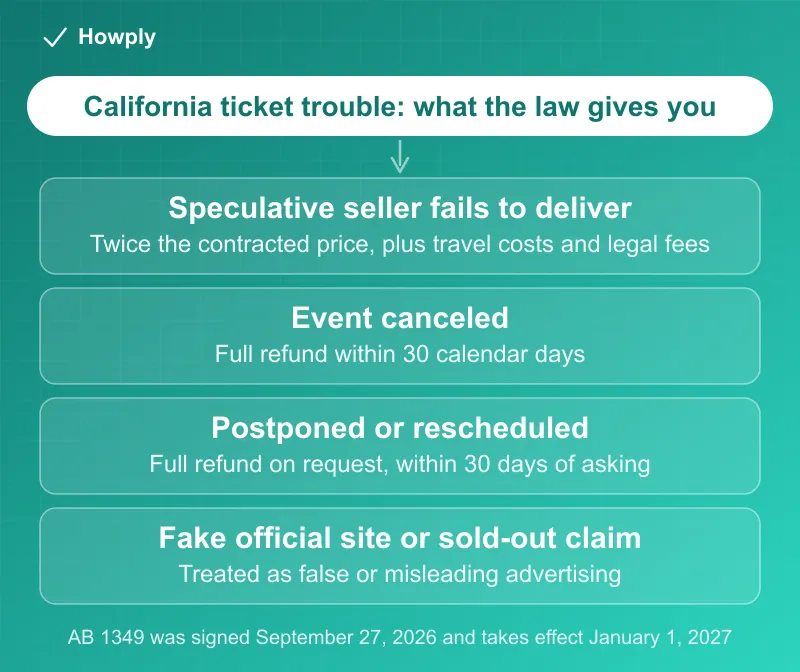
Signed September 27, 2026 and in force from January 1, 2027: sellers cannot list tickets they do not have, and a buyer left without one can recover double the price.
California rewrote its ticket-selling rules on September 27, 2026, when Governor Newsom signed AB 1349. The law targets the listing fans know as a ghost ticket: a seat advertised by someone who does not have it yet and hopes to buy it later. It also makes queue and ticket-limit evasion unlawful by name, bans lookalike “official” sites, and removes an old exemption that kept venues and their ticketing companies outside the state’s ticket chapter. The new rules take effect January 1, 2027. Here is what the signed text says, what a buyer can recover, and what is already law today.
The quick answer
- Signed, not yet in force. The bill’s official text reads “Approved by Governor September 27, 2026,” and it is now Chapter 474 of the 2026 statutes. It has no urgency clause, so under the state constitution it takes effect January 1, 2027
- No selling tickets the seller does not have. From 2027, “A ticket seller shall not engage in a speculative ticket sale”: the seller needs the ticket, “constructive possession” of it, or authorization from the event presenter or venue
- Left without a ticket? Double the price. A seller who breaks that rule and fails to deliver is “civilly liable to the ticket purchaser for two times the contracted price of the ticket,” plus nonrefundable travel costs and legal fees. This remedy has been in California law since 1994; AB 1349 extends it to original sellers, resellers, and marketplaces
- Refund rules stay at 30 days. A canceled event must be “fully refunded” within 30 calendar days; for a postponed or rescheduled event the refund is on request. AB 1349 repeals the exemption that kept primary sellers outside these rules
- Bots, queue jumping, and limit evasion become unlawful, including the use of “multiple purchaser accounts”
- Marketplaces get a lighter duty. They must not “knowingly or recklessly” facilitate a speculative sale and must “implement reasonable measures” to prevent one. The Governor’s signing message calls this “an uneven approach” and asks for more work “in the coming year”
Key facts at a glance
| Question | Answer |
|---|---|
| Status | Signed September 27, 2026; Chapter 474, Statutes of 2026 |
| In force from | January 1, 2027 |
| Speculative ticket sales | Banned for ticket sellers; marketplaces must take “reasonable measures” |
| Seller fails to deliver | Twice the contracted price, plus nonrefundable expenses, attorney’s fees and court costs |
| Event canceled | Full refund within 30 calendar days (current law, Section 22507) |
| Event postponed or rescheduled | Full refund on request, within 30 calendar days of the request |
| Buying over posted limits, evading a queue or presale code | Unlawful from 2027 |
| Lookalike sites, false “sold out” claims | Treated as false or misleading advertising |
| Exempt | Season, multigame, and playoff packages sold by the rights holder; withheld inventory |
| Pro sports | California teams, their venues, and league-owned entities keep control of their inventory |
What was signed, and when it takes effect
The bill history records the last steps: the Senate passed AB 1349 on August 31 (“Ayes 29. Noes 5.”), the Assembly concurred the same day (“Ayes 67. Noes 0.”), it was presented to the Governor on September 14, and on September 27 it was “Approved by the Governor” and “Chaptered by Secretary of State - Chapter 474, Statutes of 2026.” The Governor’s announcement lists it among the consumer bills signed that day, and its summary of the ticket measures reads: “Requiring full refunds for canceled, postponed, or rescheduled events and banning speculative tickets sales.”
The effective date comes from the state constitution, not from the bill. The chaptered text contains no urgency clause and no delayed start date, so the general rule in Article IV, Section 8 applies: “a statute enacted at a regular session shall go into effect on January 1 next following a 90-day period from the date of enactment of the statute.” For a law enacted on September 27, 2026, that is January 1, 2027. Until then, the current rules described below still apply.
The core rule: no selling what the seller does not have
New Section 22502.1 defines a “speculative ticket sale” as advertising, listing, or selling a ticket when the seller has neither of two things:
- “Actual or constructive possession of the ticket.” Constructive possession “means that the person has fully paid for the ticket, holds a legally enforceable right to receive delivery of the ticket, and has received confirmation of purchase or assignment from the original ticket seller, event presenter, or venue operator”
- “Authorization from the event presenter or venue operator to sell the ticket”
Then the rule itself: “A ticket seller shall not engage in a speculative ticket sale.” A second sentence closes the timing gap that lets listings appear the day a tour is announced: a seller may not list or sell a ticket “before the ticket has been made available for sale by the event presenter, venue operator, rights holder, or original seller,” unless it is authorized or already has constructive possession.
What this replaces matters. Under the current Section 22502.1, a seller without the ticket can still take your money if it tells you, orally and then in writing, that it “may not be able to supply the ticket at the contracted price or range of prices.” That disclosure option disappears in 2027. Possession, constructive possession, or authorization become the only ways to sell.
The section does not apply to “season ticket packages, multigame packages, inventory withheld at the sole discretion of the rights holder or venue operator, or playoff ticket packages by a rights holder or their authorized ticketing agent before the beginning of the applicable season.”
If the ticket never arrives: twice the price, plus your costs
The remedy is in Section 22502.3. As amended by AB 1349, “a ticket seller, original seller, ticket reseller, or ticket retail marketplace that violates Section 22502.1 or 22502.2 and fails to supply a ticket at or below a contracted price or within a contracted price range shall be civilly liable to the ticket purchaser for two times the contracted price of the ticket, in addition to any sum expended by the purchaser in nonrefundable expenses for attending or attempting to attend the event in good faith reliance on seat or space availability, and reasonable attorney’s fees and court costs.”
Two points for buyers:
- This is not new money, it is a wider net. The current Section 22502.3, in place since 1994, already gives the same double recovery against “a ticket seller who violates Section 22502.1 or 22502.2.” AB 1349 names original sellers, resellers, and marketplaces alongside ticket sellers, and because the underlying rule becomes a flat ban, more failed deliveries will count as violations
- Travel is covered. “Nonrefundable expenses for attending or attempting to attend the event” reaches the flight and hotel booked around tickets that never came, as long as you relied in good faith on the seats being available
The statute creates civil liability to the purchaser; it does not pay out on its own. Marketplace guarantees are a separate, contractual promise that you claim through the platform itself. How the statute is enforced in an individual case is a question for a lawyer or for the California courts’ small claims guide.
Canceled or postponed: the 30-day refund rule, and who it now reaches
The refund rule itself is existing law and AB 1349 does not rewrite it. Section 22507 says:
- “The ticket price of an event which is canceled shall be fully refunded to the purchaser by the ticket seller within 30 calendar days of the cancellation”
- The ticket price of an event “which is postponed, rescheduled, or replaced with another event at the same date and time, shall be fully refunded to the purchaser by the ticket seller upon request within 30 calendar days of the refund request”
What changes is who is inside the chapter. Today Section 22503.5 reads: “This chapter does not apply to any primary contractor or seller of tickets for the primary contractor operating under a written contract with the primary contractor,” where the primary contractor is the organization responsible for the event. AB 1349 repeals that section without a replacement. The bill’s official digest describes the aim as imposing “similar requirements, as applicable, to original sellers, event presenters, ticket resellers, and ticket resale marketplaces.”
Note the difference between the two cases: a canceled event is refunded without a request, while a postponed or rescheduled one is refunded “upon request.” If a new date does not work for you, ask. For how platform policies compare with this floor, see our guides to how AXS tickets work and Allianz ticket protection, and for slow refunds, how long a refund takes.
For how Ticketmaster and AXS treat resale tickets when a show changes, see our resale ticket refunds guide.
Bots, queue jumping, and ticket limits
New Section 22505.5 makes it unlawful to knowingly use, provide, or sell “software or services” to do any of these:
- “Purchase tickets in excess of posted limits for an online event ticket sale”
- “Circumvent or evade an electronic queue, waiting period, presale restriction or presale code, ticket purchasing limit, account limitation, or other ticket distribution control established and disclosed by the event presenter, venue operator, rights holder, or ticket seller”
- “Circumvent or disable a security measure, access control system, or other control or measure used to facilitate authorized ticket sales or authorized entry into an event”
- Use “multiple Internet Protocol addresses, multiple purchaser accounts, multiple email addresses, or other technological means” to exceed posted limits
For ordinary buyers, the practical reading is that the things ticketing platforms already punish by canceling orders also become unlawful under state law. Staying inside the posted limit and using one account is the safe pattern; how the queue and presale controls work is in our guides to the Ticketmaster queue and Ticketmaster presales.
One carve-out is written into the same section: nothing in the chapter restricts “a California-based professional sports team, a sports venue operator,” or a league-owned entity from “withholding, reserving, managing, transferring, or allocating ticket inventory for operational or business purposes.”
Lookalike sites and “sold out” claims
New Section 22505.6 goes after the marketing. It bars using a website, domain name, logo, or other identifying feature “that is substantially similar to, or likely to be confused with, that of an event presenter, venue operator, rights holder, original seller, or authorized agent” when it is likely to confuse a reasonable consumer. And it names four things a seller may not represent or imply:
- That “a ticket is available from an authorized source when the ticket is being offered through resale”
- That an event “is sold out when tickets remain available from the original seller or an authorized seller”
- That you are buying from the presenter, venue, or original seller “when the consumer is purchasing from a reseller or ticket resale marketplace”
- That “a ticket listing reflects a specific seat, section, row, or location if the seller does not have a reasonable basis to make that representation”
“A violation of this section constitutes false or misleading advertising” under California’s false advertising law. If you run into a site like this, the California Attorney General takes reports through its consumer complaint form.
What marketplaces have to do, and the Governor’s caveat
Resale marketplaces are handled differently from sellers. The definition of a speculative sale covers a sale “by a person other than a ticket resale marketplace,” so the flat ban does not land on the marketplace itself. Its duty is in a separate sentence: a marketplace “shall not knowingly or recklessly process payment, collect a fee, advertise, list, market, offer for sale, contract for sale, accept payment for, or facilitate the completion of a speculative ticket sale, and it shall implement reasonable measures designed to prevent speculative ticket sales on its platform.” The law does not define those reasonable measures.
That gap is the contested part of the law, and the Governor said so while signing it. His signing message says the measure “appears to take an uneven approach, allowing select ticket sellers to avoid certain obligations under the bill,” that “such a carve-out deserves further discussion,” and that he encourages the author “to continue to work with stakeholders to refine this policy in the coming year.” A follow-up bill in 2027 is therefore possible, and this page will be updated if one is introduced.
One definition widens the law’s reach in the other direction: a “ticket resale marketplace” includes “an original seller to the extent that the original seller operates a website or other online application that advertises, lists, markets for sale, processes payments for, or facilitates resale or original sale of tickets that were not offered to the general public during the public onsale.” A primary ticketing company is treated as a marketplace when it runs resale or sells inventory that never reached the public onsale.
What to do as a buyer
- Before 2027, read listings the old way. Until January 1, a seller may still list a ticket it does not hold if it makes the disclosure current law requires. A listing with no seat, row, or section that appears before the public onsale deserves a second look
- Keep the paper trail. Save the listing, the order confirmation with the contracted price, and receipts for nonrefundable travel. The double recovery is measured from the contracted price, and the expense claim depends on proof
- Use the marketplace guarantee first. It is a claim you make to the platform itself, with no court involved
- Canceled event: watch the 30 days. Postponed event: ask. The refund for a postponed or rescheduled event is owed on request, so send the request in writing and note the date
- Report deceptive sites to the California Attorney General’s consumer complaint form, linked above
The price-display rule already in effect since May 12, 2025 is covered in our guide to how all-in ticket pricing works.
Quick answers to what people search
Is AB 1349 law now? It was signed on September 27, 2026 and chaptered the same day, so it is enacted. Its rules take effect January 1, 2027.
What is a ghost ticket, or speculative ticket? In the law’s words, a ticket offered by a seller who has neither “actual or constructive possession of the ticket” nor authorization from the event presenter or venue operator to sell it.
Does the law ban ticket resale in California? No. It bans speculative sales and deceptive selling practices. A seller who actually holds the ticket is outside the law’s definition of a speculative sale.
Can I get double my money back if a reseller never sends my ticket? The statute makes a seller that violates the rules and fails to supply the ticket liable for “two times the contracted price of the ticket,” plus nonrefundable expenses and legal fees. That is a civil claim against the seller, not an automatic payment.
Does this apply to Ticketmaster and venues, or only resellers? From 2027 the exemption for primary contractors is repealed, and an original seller counts as a resale marketplace when it runs resale or sells tickets that were not offered in the public onsale.
Does the law cap resale prices? No. Nothing in the chaptered text sets a price cap.
Bottom line
AB 1349 is signed and takes effect January 1, 2027. From then, a seller in California needs the ticket, a paid and confirmed right to it, or the presenter’s authorization before listing it; a buyer left without a ticket can pursue twice the contracted price plus travel costs; bots, queue jumping, and limit evasion are unlawful; and fake official sites and false sold-out claims count as false advertising. The 30-day refund rule for canceled and postponed events already exists and now reaches primary sellers too. The open question is the lighter standard for resale marketplaces, which the Governor flagged for more work in the coming year.
Provisions quoted from the chaptered text of AB 1349 (Chapter 474, Statutes of 2026), the bill history, the Governor’s announcement and signing message, the California Constitution, and the current Business and Professions Code sections linked above, all read on September 29, 2026. This guide describes the law; it is not legal advice.
Official sources
- California Legislature: AB 1349, chaptered text (Chapter 474, Statutes of 2026)
- California Legislature: AB 1349 bill history
- Governor of California: bill signing announcement (September 27, 2026)
- Governor of California: AB 1349 signing message (PDF)
- California Constitution, Article IV, Section 8 (when statutes take effect)
- California Business and Professions Code 22507 (refunds for canceled and postponed events)
- California Business and Professions Code 22502.3 (current double-recovery rule)
- California Business and Professions Code 22502.1 (current law, replaced by AB 1349)
- California Business and Professions Code 22503.5 (current exemption, repealed by AB 1349)
- California Attorney General: consumer complaint against a business
- California Courts Self-Help Guide: small claims