How All-In Ticket Pricing Works: What Must Be in the Price You See
Since May 12, 2025, ticket sellers must show the total price with mandatory fees. What taxes and add-ons can still come later, and how to report a violation.
A ticket listed at $79 that turns into $110 at checkout used to be normal. A federal rule now says the first price has to be the real one. The Federal Trade Commission’s Rule on Unfair or Deceptive Fees is “effective May 12, 2025,” and it covers live-event tickets from any seller, including resellers. This guide explains what the price you see must include, the three kinds of charge that can still show up later, what the FTC calls a misleading fee, and what to do when a checkout page does not match.
The quick answer
- The rule: a business that shows ticket prices must “tell people upfront the total price they will pay for live-event tickets”
- What counts: the total price “includes all charges or fees the business knows about and can calculate upfront, including charges or fees for mandatory goods or services people have to buy as part of the same transaction”
- What can wait: “Businesses may only exclude three categories of charges from the total price: government charges, shipping charges, and fees or charges for optional ancillary goods or services that people choose to add to the transaction”
- Before you pay: the seller must “add in any previously excluded charges and display the final amount of payment as prominently as, or more prominently than, the total price”
- Resellers are covered: the rule applies to “third-party platforms, resellers, and travel agents”
- It does not cap fees. The rule text sets no limit on how big a fee can be; it governs how prices are shown and described
- If it looks wrong: the FTC takes reports at reportfraud.ftc.gov, through a link built for hidden fees
Key facts at a glance
| Question | Answer |
|---|---|
| Effective date | May 12, 2025 |
| Covered tickets | Concerts, sporting events, theater, and other live performances; film screenings are generally not covered |
| Who must comply | Any business offering or advertising live-event tickets, online or in person, including resellers and platforms |
| Must be in the displayed price | Mandatory fees you cannot avoid, such as a required online purchase fee |
| May be added later | Taxes and other government charges, shipping, and optional add-ons you choose |
| Credit card surcharge | In the price if card payment is required; may be added later if another fee-free option exists |
| Price prominence | The total price must be the most prominent number; the final amount at payment must be at least as prominent |
| Fee names | Sellers must say what a fee is for and avoid vague labels |
| Penalties | Compliance orders, refunds to consumers, and civil penalties |
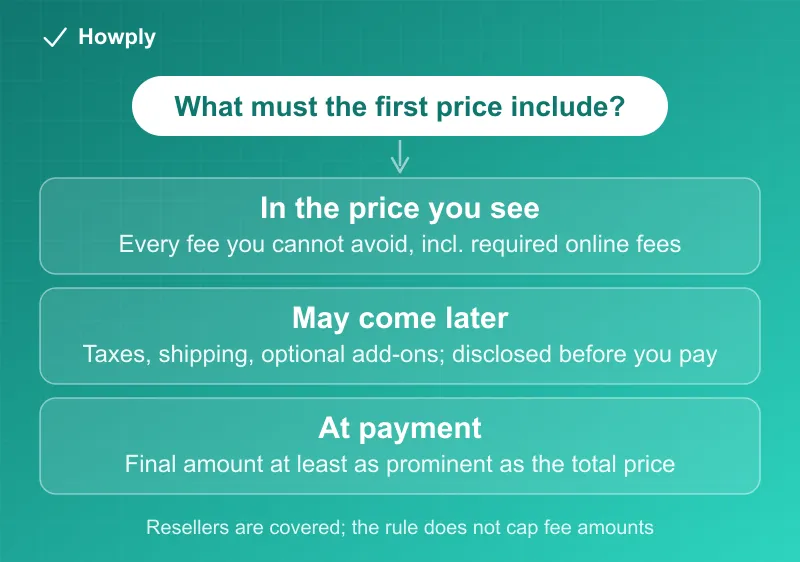
What the price you see must include
The rule’s definition, in 16 CFR 464.1, is that “Total price means the maximum total of all fees or charges a consumer must pay for any good(s) or service(s) and any mandatory ancillary good or service, except that government charges, shipping charges, and fees or charges for any optional ancillary good or service may be excluded.” In plain terms, if you must pay it to buy the ticket, it belongs in the first price.
The FTC’s FAQ lists four conditions that make a fee mandatory. It is mandatory if people are required to pay it no matter what, if they “can’t reasonably avoid” it, if it pays for something needed to make the ticket usable, or if people “can’t effectively agree to” it because of “default billing, pre-checked boxes, or opt-out provisions.” Its own ticket example is direct: “An online ticket retailer requires people to pay a fee to purchase live-event tickets online. The fee cannot be avoided and must be included in the total price.”
Three details catch people out:
- Card fees: “If a business requires people to pay with a credit card, the credit card fee is mandatory and must be included in the total price.” But if there is “another viable payment method” without a fee, using the fee-carrying one is optional and the fee can be disclosed later
- Handling: “Handling charges are not shipping charges. A business must include handling charges in the total price”
- Itemizing: sellers may break fees out, but “the total price must be clear, conspicuous, and most prominent,” and the FTC says a seller must “describe what fees are for and avoid vague phrases” such as convenience, service, or processing fees
What can still be added later
Only three kinds of charge may be left out of the first price, and each must still be disclosed before you pay:
- Taxes and other government charges
- Shipping charges, which must “reasonably reflect a business’s costs to ship physical goods”
- Optional extras you pick, such as a VIP package. The FTC’s example is a venue that sells a $150 ticket and a $200 VIP package, and treats the package as optional
The disclosure has to arrive “before a business prompts people to pay” and include “the nature, purpose, and amount” of each excluded charge. Then comes the last number: “Before asking for payment, a business must add in any previously excluded charges and display the final amount of payment as prominently as, or more prominently than, the total price.” So your last screen should show one number that already includes tax and anything you added.
Fees that depend on your choices are treated differently. A theater may advertise the lowest general admission total price, but “only if people can actually buy tickets at that price and the pricing information is not otherwise misleading.” A “from” price that no seat actually sells for does not meet that test.
What the FTC calls a misleading fee
Rule section 464.3 bars misrepresenting “the nature, purpose, amount, or refundability of any fee or charge.” The FAQ gives ticket examples worth recognizing:
- A seller says a fee “is required by the government when it is not”
- A resale site shows a “taxes and fees” line that “inflates the actual government taxes and fees because it includes an amount that the ticket seller keeps as profit”
- A seller “advertises it has tickets available for a sold-out concert at a certain price but doesn’t actually have those tickets”
Promotions have a rule of their own: “If a promotion is available only to some people, such as people who enroll in a rewards program, the total price is the price offered to everyone.” A member-only price can be shown, but the everyone price must be the most prominent one. Dynamic pricing is allowed: “Businesses may use dynamic pricing strategies to adjust prices, for example, based on demand or inventory, so long as the pricing information is not misleading.”
What changed on Ticketmaster and resale sites
Ticketmaster said on May 12, 2025 that it “officially launched All In Prices in the U.S.” and shows “the full price of tickets, including all fees (before taxes), upfront from the moment fans begin shopping.” Resale sites are in the same position, because the FAQ says the rule covers resellers and that marketplaces, “including those in the secondary ticket market,” must “give sellers the information necessary to calculate the total price.” If a platform displays prices for a seller, “they must display the total price.”
State law can add to this. The FAQ says “If a state or local law or regulation gives people greater protections than the Rule, businesses must comply with the Rule and the greater protections.” California’s new ticket law, which takes effect on January 1, 2027 and is covered in our AB 1349 guide, adds rules for resale and refunds.
A 60-second checkout checklist
- Compare the first price and the last. Any gap should be taxes, shipping, or something you chose to add
- Look for pre-checked boxes. Under the FTC’s reading, a fee you must opt out of is not optional
- Read the fee labels. A line that only says “service fee” or “processing fee” does not tell you what it is for
- Check the card surcharge. If it applies only to cards and another payment option is fee-free, it can be listed later; if card is your only option, it belongs in the price
- Screenshot each page if the total changes, including the first price and the final amount
- Check what you are buying. For sold-out shows, ask whether the listing is real inventory before you pay a premium
If the price changes at checkout
Take the screenshots, then use the FTC’s report link at reportfraud.ftc.gov, which the FAQ describes as the way to report “possible violations.” Businesses that break an FTC trade rule “could be ordered to bring their practices into compliance, refund money back to consumers, and pay civil penalties.” If you already paid, our guide to disputing a subscription or card charge with your bank covers the steps, and the fee evidence you saved is what a dispute needs.
Quick answers to what people search
Do ticket sites have to show the full price now? Yes, for live-event tickets: the total price, with mandatory fees, must be shown upfront and most prominently. Taxes, shipping, and optional add-ons can come later but must be disclosed before payment.
Does the rule apply to resale tickets? Yes. The FAQ says it covers third-party platforms and resellers.
Does the rule make fees cheaper? The rule text contains no cap on fee amounts. It decides when you see fees and how they are described.
Can a site still add taxes at checkout? Yes. Government charges may be excluded from the first price if they are disclosed before payment and included in the final amount.
Is a credit card fee part of the price? If card payment is required, yes. If another payment method has no fee, the card fee is optional.
Where do I report a hidden fee? At reportfraud.ftc.gov, using the hidden-fees report link the FTC provides.
Bottom line
Since May 12, 2025, the first price for a live-event ticket has to include every fee you cannot avoid, with only taxes, shipping, and optional add-ons allowed to arrive later and only if disclosed before payment. The final amount must be at least as prominent as the total price, fees must be described honestly, and resellers are covered. The rule does not cap fees, so compare the all-in number across sites, screenshot anything that changes, and report mismatches to the FTC.
Rule text, definitions, and examples quoted from the FTC’s Frequently Asked Questions, 16 CFR Part 464 on eCFR, the January 10, 2025 Federal Register notice, and Ticketmaster’s May 12, 2025 press release, all linked above, verified on September 30, 2026. The FTC may revise its guidance, and this guide will be updated with the revision noted.