Tift Regional Health Data Breach Settlement: How to Claim by October 15
Notified about the August 2022 Tift Regional or Southwell cyberattack? A $1.2M settlement won final approval. File by Oct. 15 for $75 or up to $5,000, plus monitoring.
If you got a notice about the August 2022 cyberattack on Tift Regional Health System and Southwell, you have until October 15, 2026 to claim a share of a $1,200,000 settlement. The settlement website says “The only way to receive benefits or payments from this Settlement is by submitting a valid and timely Claim Form.” The court has already approved the deal, a fact the site’s FAQ and dates pages do not yet reflect, and the paper forms and the online page disagree on two details that matter: the cap on documented losses and the mailing deadline. This guide covers who is in, the three benefits, how to file, and what to watch for.
The quick answer
- Who is in: “All individuals residing in the United States whose Private Information may have been compromised or otherwise impacted in the Data Security Incident, including all those who received notice of the breach”
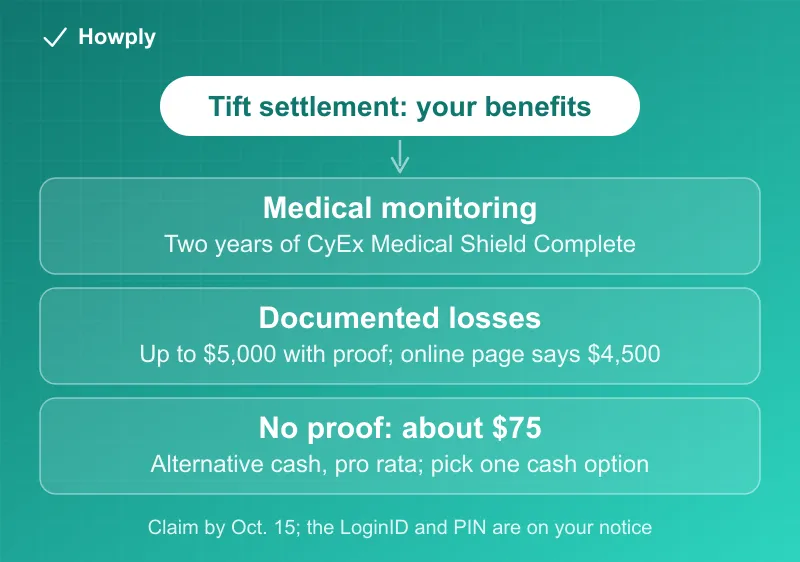
- Credit monitoring: two years of CyEx Medical Shield Complete, with “$1 million of medical identity theft insurance”
- Cash Payment, documented losses: up to $5,000 with proof, for losses between August 11, 2022 and October 15, 2026. The online claim page says $4,500, so check which figure applies to you
- Cash Payment, no proof: an alternative payment “expected to be $75.00, but may be larger or smaller depending on the total claims filed”
- Deadline: October 15, 2026 online or by email, or mailed with a postmark no later than that date. One form of the paper claim says claims “must be received” by the 15th, so do not cut it close
- To file online you need the LoginID and PIN printed on your notice
- Court status: the court granted final approval and signed the judgment on September 24, 2026. Payments come after any appeals are resolved
- Opting out and objecting closed on September 15, 2026
Key facts at a glance
| Question | Answer |
|---|---|
| Case | In re Tift Regional Health System, Inc. Data Breach Litigation, No. 2023CV0313, Superior Court for Tift County, Georgia |
| Defendants | Tift Regional Health System, Inc. and Southwell, Inc. |
| Settlement fund | $1,200,000 |
| Data that may have been involved | ”names; dates of birth; Social Security numbers; and medical information” |
| Credit monitoring | Two years of CyEx Medical Shield Complete |
| Documented loss payment | Up to $5,000 per the notice, FAQ, and paper form; $4,500 on the online claim page |
| Alternative cash payment | Expected $75, pro rata |
| Claim deadline | October 15, 2026 |
| Payment methods on the paper form | PayPal, Venmo, Zelle, a virtual prepaid card, or a physical check |
| Mail address | Tift Data Security Incident Settlement, c/o Settlement Administrator, P.O. Box 25226, Santa Ana, CA 92799-9958 |
| Email and phone | info@TiftDataSettlement.com and (833) 421-7345, toll free |
| Final approval | Granted and signed September 24, 2026 |
What the incident and the lawsuit are about
The settlement site describes “the targeted cyberattack on Tift’s computer systems that occurred in August 2022,” in which files containing private information were accessed. The information “may have contained personal information such as names; dates of birth; Social Security numbers; and medical information.” The defendants are Tift Regional Health System, Inc. and Southwell, Inc.
The court has decided nothing about fault. The site says “Tift denies that it did anything wrong, and the Court has not decided who is right,” and the final order says it is not to be construed as “an admission by the Defendants of any liability, claim or wrongdoing.”
Who is in the class
The court’s definition is broad: “All individuals residing in the United States whose Private Information may have been compromised or otherwise impacted in the Data Security Incident, including all those who received notice of the breach.” The home page narrows it to people “identified by Tift’s records who are entitled to benefits under the Settlement,” and says “Class Members may have received a previous notice directly from Tift.” Your notice carries your login details for the online form.
If you are not sure whether you are in, the notice says “you can ask for free help any time” by email at info@TiftDataSettlement.com, by phone, toll free, 24 hours a day at (833) 421-7345, or by mail at the P.O. box above.
The benefits
| Benefit | What you get | What it takes |
|---|---|---|
| Credit monitoring | ”two years of CyEx Medical Shield Complete,” with monitoring for “healthcare insurance ID exposure,” “Medical Record Number (MRN) exposure,” and “unauthorized Health Savings Account (HSA) spending” | Check the box on the claim |
| Documented loss payment | Up to $5,000 for out-of-pocket losses “between August 11, 2022, and October 15, 2026” | Proof such as bank statements or receipts |
| Alternative cash payment | A one-time pro rata payment, expected $75 | Nothing to document |
You can enroll in monitoring and take one of the two cash options. The paper form says “DO NOT CLAIM THIS BENEFIT IF YOU ARE CLAIMING PAYMENTS FROM SECTION IV” on the documented loss section, so pick one cash option, not both.
What counts as a documented loss: “losses because of identity theft or fraud,” “fees for credit reports, credit monitoring, or freezing and unfreezing your credit,” “cost to replace your IDs,” and “postage to contact banks by mail.” The notice says “You need to send proof, like bank statements or receipts, to show how much you spent or lost.” You may add your own notes, but “those notes or papers alone are not enough to make a valid claim.” And “You cannot claim a payment for expenses that have already been reimbursed by a third party.”
The monitoring benefit is aimed at medical identity theft, which fits a health system’s data: the service covers insurance ID and medical record number exposure and unauthorized Health Savings Account spending, and offers “a fraud resolution agent to help fix any problems.”
The $4,500 versus $5,000 mismatch
The notice, the FAQ, and the paper claim form all say a documented loss claim can get back “up to $5,000.00.” The online claim page says “can get back up to $4,500.00.” Four documents say $5,000: the notice, the FAQ, the paper form, and the postcard text in the exhibits to the settlement agreement. That makes the online page’s $4,500 look like an inconsistency rather than a changed term, but we cannot see how the online form enforces a cap. If your documented losses are above $4,500, email info@TiftDataSettlement.com before filing, or use the paper form that states $5,000 and mail it with time to spare.
What the $75 depends on
The alternative payment is not fixed. The notice says “It is expected that a significant amount of money will remain in the Settlement Fund after all expenses and all other benefits have been paid. All of this remaining money will be divided equally between everyone who claims an Alternative Cash Payment.” And it adds “This payment is expected to be $75.00, but may be larger or smaller depending on the total claims filed.”
The court’s order shows what comes out of the $1,200,000 first: attorneys’ fees of $360,000.00, litigation expenses of $47,495.51, and service awards of $2,500.00 for each of four class representatives, a total of $10,000.00. That leaves $782,504.49 before the administrator’s costs and the credit monitoring, which our arithmetic can only bound. Each $75 payment uses $75 of what remains, so every 1,000 alternative cash claims takes $75,000. The administrator, not us, sets the final figure after the claims are counted.
How to file
Online. The claim page says “To start your online claim form, you must login with your LoginID and PIN. You can find your ID and PIN on the Notice that was sent to you.” If you lost it: “Please request your ID and PIN by providing your full name and mailing address,” by emailing info@TiftDataSettlement.com.
By mail. Download the paper form from the site, complete and sign it, and send it with your proof to the P.O. box above. The paper form says “Do not mail or deliver your Claim Form to the Court, the Settling Parties, or their counsel.” It also asks you to “Submit only one Claim Form, online or paper, per person” and warns “If you submitted a request to be excluded from the Settlement, do not submit a claim.” A section of the form asks you to attest: “I swear and affirm on penalty of perjury that the information provided in this Claim Form, including supporting documentation, is true and correct to the best of my knowledge.”
By email. The paper form says “An electronic image of the completed Claim Form can also be emailed to info@TiftDataSettlement.com,” and the claim page confirms “The deadline to submit a Claim Form online or by email is October 15, 2026.”
The mailing deadline reads two ways. The notice says a mailed claim “must be postmarked no later than October 15, 2026,” and the claim page says it “must be mailed with a postmark date no later than October 15, 2026.” The first page of the paper claim form, though, says “Claims must be received by October 15, 2026” and, a few lines later, “Paper Claim Forms must be mailed through the United States Postal Service no later than October 15, 2026.” If you mail it, treat the 15th as the day it should arrive, or file online or by email instead.
On the paper form you also pick how to be paid: PayPal, Venmo, Zelle, a virtual prepaid card, or a physical check.
The court has already approved the settlement
The notice and the site’s FAQ and dates pages still say the final approval hearing would be held on September 14, 2026. The signed judgment posted on the settlement site’s documents page tells a different story. It says the court heard the motion “at the Final Approval Hearing before this Court on September 17, 2026,” and that “the Court grants final approval of the Settlement Agreement.” The judge “fully, finally, and unconditionally approves the Settlement.” The order is dated September 24, 2026 and carries the clerk’s e-filing stamp for that day at 11:15 a.m.
Two more facts from the order: “zero (0) Settlement Class Members submitted objections and zero (0) Settlement Class Members opted-out.” And what happens next: “Upon the Effective Date, the Action shall be, and hereby is dismissed with prejudice in its entirety as to Defendants.” The court keeps the case open to oversee the settlement, “retains continuing jurisdiction” over how the settlement is carried out, and the notice says “Settlement payments will be distributed if the Court grants final approval, and after any appeals are resolved.” The site gives no payment date. The copy of the order we read is headed “[PROPOSED] Final Approval Order and Judgment” but carries the judge’s signature and the clerk’s stamp.
What doing nothing means
The site says “Unless you opt out of the Settlement, you are automatically part of the Settlement. If you do nothing, you will not receive benefits or payments from this Settlement and you will give up the right to sue, continue to sue, or be part of another lawsuit against the Defendant related to the legal claims resolved by this Settlement.” The deadlines to opt out and to object were September 15, 2026, so those choices are closed. The notice says of the release that “you won’t be able to be part of any other lawsuit against Tift about the issues that this Settlement covers.”
Check that it is real
The notice states “A court has authorized this notice. This is not a solicitation from a lawyer.” File only on the official site or by mail to the administrator, and treat any message that asks for a fee or a bank login as suspect. The notice also says “DO NOT CONTACT THE COURT OR CLERK OF COURT REGARDING THIS SETTLEMENT.” Our October 2026 settlement deadlines guide lists the other claim windows closing this month, and our guide to the Doxim data breach settlement covers another data breach claim due October 13.
Quick answers to what people search
Is the Tift Regional data breach settlement real? Yes. It is a Georgia state court class action, No. 2023CV0313, with a $1,200,000 fund and a signed final approval order dated September 24, 2026.
How much will I get from the Tift settlement? Credit monitoring for two years, plus either up to $5,000 with proof or an expected $75 without. The $75 can rise or fall.
What is the Tift settlement claim deadline? October 15, 2026, online or by email, or mailed with a postmark by that date.
I lost my notice. Can I still file online? Email info@TiftDataSettlement.com with your full name and mailing address to request your LoginID and PIN.
Can I claim both cash payments? No. The form says to choose one cash option.
Can I still opt out? No. That deadline was September 15, 2026.
When will payments go out? After any appeals are resolved. The site has not posted a date.
Bottom line
If you got a notice about the August 2022 Tift Regional or Southwell cyberattack, file by October 15, 2026. Online filing needs the LoginID and PIN from the notice, and email is accepted too. Choose the no-proof $75 payment unless you have documents for real losses, in which case the documented route pays up to $5,000, and note that the online page shows $4,500. Add the two years of medical identity monitoring either way. The court gave final approval on September 24, 2026, so the settlement is moving toward payment, with no date posted and appeals a possible delay. Opting out and objecting are closed, so doing nothing just means no benefits and a release of your claims.
Class definition, benefits, deadlines, claim instructions, and contact details quoted from the court-authorized settlement website, its FAQ, dates, and claim pages, the long-form notice, and the paper claim form, read on October 3, 2026. The final approval details are from the signed Final Approval Order and Judgment posted on the site’s documents page, which is a scanned image that we read page by page. The $782,504.49 remainder is our arithmetic from the order’s amounts; the administrator’s costs and the credit monitoring cost are not stated. Settlement terms can change, and the settlement site is the authority on your claim. This is general information, not legal advice.
Official sources
- In re Tift Regional Health System, Inc. Data Breach Litigation settlement website (home page, rights and options)
- Tift Regional settlement: Frequently Asked Questions
- Tift Regional settlement: claim form login and benefit summary
- Tift Regional settlement: Important Dates
- Tift Regional settlement: long-form notice (PDF)
- Tift Regional settlement: paper claim form and release (PDF)
- In re Tift Regional Health System, Inc. Data Breach Litigation: Settlement Agreement and exhibits (PDF)
- In re Tift Regional Health System, Inc. Data Breach Litigation: Final Approval Order and Judgment (PDF, September 24, 2026)