How to File the Homebuyer Commission Settlement Claim by October 27
Bought a home listed on an MLS? The $120.3M homebuyer commission settlement needs a claim and your closing statement by October 27. Class dates by state.
Most of the real estate commission settlements you have read about paid home sellers. This one is for buyers. Tuccori v. At World Properties, in federal court in Chicago, settles claims that the National Association of Realtors and 24 brokerage groups kept buyer-broker commissions artificially high, and the defendants are paying $120,334,500 combined. If you bought a home that was listed on an MLS and a brokerage was paid a commission, you may be in the class, but only a claim form filed online or postmarked by Tuesday, October 27, 2026 gets you a payment, and unlike most consumer claims this one requires paperwork from your closing. Here is what the court-authorized site says about the dates that apply in your state, the proof you need, and why the money will arrive in pieces over several years. The other October deadlines are in our October claim deadlines tracker.
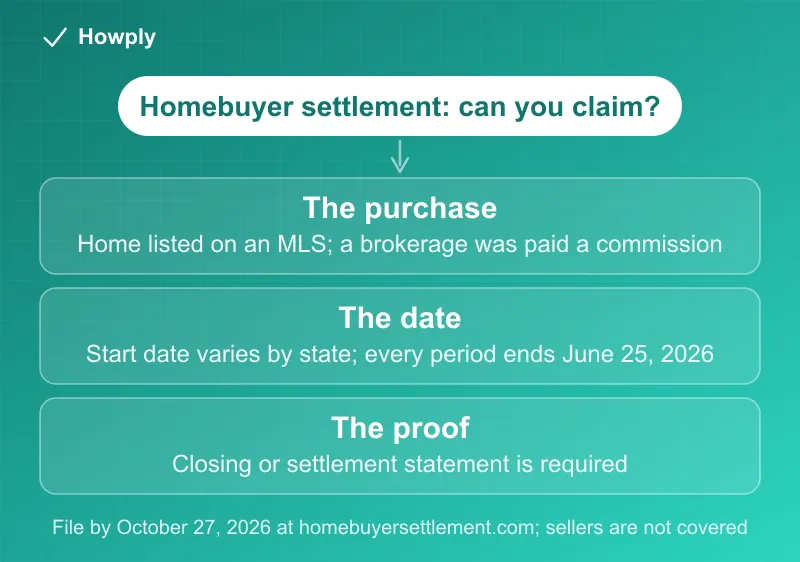
The quick answer
- Deadline: “All Claim Forms must be submitted online or postmarked no later than October 27, 2026”
- Who: “All persons who purchased a home that was listed on an MLS anywhere in the United States where a commission was paid to any brokerage in connection with the transaction during the Class Periods”
- The dates depend on your state. Every class period ends June 25, 2026. The start ranges from January 25, 2006 (Puerto Rico) to December 8, 2019, with most states falling between 2015 and 2019. Tables below
- Proof is required. You “must also submit all required Proof of Documentation, such as a closing statement, settlement statement, HUD statement, settlement letter, or other transaction documents”
- Sellers are not covered: “Generally no. Membership in the Settlement Class is based on home purchases”
- Amount and timing: “it is not known exactly how much each Settlement Class Member will receive or when payments will be made,” and payment comes as “multiple payments issued to the Class Members over a period of several years”
- Opt-out and objection deadlines have passed. Both were September 17, 2026. Your remaining choice is to file or not
- Official site: homebuyersettlement.com, run by the administrator Epiq. Help is at Info@HomeBuyerSettlement.com or 1-877-417-7662
Key facts at a glance
| Question | Answer |
|---|---|
| Case | Tuccori et al. v. At World Properties, LLC et al., N.D. Ill., No. 1:24-cv-00150, Judge Lindsay C. Jenkins |
| Settlement fund | $120,334,500 |
| Largest contributors | National Association of Realtors $52,250,000; HomeServices of America group $30,000,000 |
| Who is covered | Buyers of MLS-listed homes where any brokerage was paid a commission |
| Class period | Starts on a state-specific date, ends June 25, 2026 |
| Claim deadline | October 27, 2026, online or postmarked |
| Proof to file | Closing statement, settlement statement, HUD statement, or similar |
| Opt-out and objection | Closed September 17, 2026 |
| Final fairness hearing | November 2, 2026, 9:30 a.m., Dirksen U.S. Courthouse, Chicago |
| Payment | Pro rata, in more than one payment over several years |
Who is in the class
The definition on the settlement site has three parts: you purchased a home, it “was listed on a Multiple Listing Service,” and “a commission was paid to any brokerage as part of the transaction.” The word is “any.” The FAQ’s definition does not say the brokerage in your deal had to be one of the defendants.
It also does not matter which MLS it was. “For avoidance of doubt, the Settlement Class includes persons who purchased a home listed on any MLS, regardless of affiliation with The National Association of Realtors,” and the FAQ names the Real Estate Board of New York, the REBNY Residential Listing Service, the Northwest Multiple Listing Service, West-Penn Multi-List, and MLS Property Information Network as included.
Who is out: people who opted out, the lawyers and court staff involved, and, for the overlapping claims only, people who already released the same claims against a settling defendant in the home seller cases.
The class period for your state
This is the part that takes work. “The Class Periods vary by state and Defendant,” and the FAQ publishes two sets of dates. Every period ends on June 25, 2026.
Dates tied to the National Association of Realtors, Anywhere Real Estate, Compass, eXp, HomeServices of America (with BHH and HSF Affiliates), Hanna Holdings, United Real Estate, and Douglas Elliman:
| Home listed in | Class period starts |
|---|---|
| Puerto Rico | January 25, 2006 |
| Rhode Island, Louisiana | January 25, 2011 |
| Wyoming | January 25, 2013 |
| Alabama, Connecticut, Hawaii, Indiana, Maine, Massachusetts, Michigan, Minnesota, New Jersey, New York, North Dakota, Ohio, Oregon, Pennsylvania, South Dakota, Tennessee, Vermont, Wisconsin | January 25, 2015 |
| Arkansas, Kentucky, Illinois, Iowa, Missouri, Utah, West Virginia | January 25, 2016 |
| Arizona, California, Washington D.C., Delaware, Georgia, Idaho, Nebraska, Nevada, New Hampshire, New Mexico, North Carolina, Virginia | January 25, 2017 |
| Alaska, Colorado, Kansas, Maryland, Mississippi, Montana, Oklahoma, South Carolina, Washington | January 25, 2018 |
| Texas and all other homes across the United States | January 25, 2019 |
Dates tied to the other settling brokerages (@properties, Baird & Warner, Real Estate One, Silvercreek, Equity Real Estate, NextHome, Realty Executives, Shorewest, Side, Engel & Volkers, Keyes and Illustrated Properties, The Real Brokerage, Vanguard Properties, Fathom, HomeSmart, Realty ONE Group, and The Agency):
| Home listed in | Class period starts |
|---|---|
| Alabama, Georgia, Indiana, Maine, Michigan, Minnesota, New Jersey, Pennsylvania, Tennessee, Vermont, Wisconsin, Wyoming | December 8, 2017 |
| Arkansas, Illinois, Kentucky, Missouri | December 8, 2018 |
| All other homes across the United States | December 8, 2019 |
In every state the first table’s start date is the earlier of the two, so it is the one to check first. A New York purchase in 2016 falls inside the first table and outside the second; a Florida purchase in 2018 falls outside both, because Florida is an “all other homes” state in each table. The FAQ does not explain how the two sets of dates interact for a buyer whose own brokerage was not a defendant, so if your purchase sits between the two dates, file and let the administrator apply the allocation plan, or call 1-877-417-7662 first.
Sellers, and people who both bought and sold
“Does the Settlement include home sellers? Generally no. Membership in the Settlement Class is based on home purchases. Merely having sold a home is not a basis for membership.”
Sellers were covered by separate cases, which the FAQ lists: Burnett, Gibson, Keel, and 1925 Hooper. If you sold one home and bought another, the buyer claim is still open to you for the purchase. The limit is narrow: you are excluded “as to any claims released in the home seller settlements,” and “may not receive a payment for those released claims.” The FAQ states that this settlement “does not overlap with any of the existing home seller settlements.”
The proof you need before you start
This is not a no-receipts claim. The claim instructions say you “will be asked to verify Proof of Purchase Documentation” and “must also submit all required Proof of Documentation, such as a closing statement, settlement statement, HUD statement, settlement letter, or other transaction documents provided to you during the sale and closing of your home purchase transaction.”
Practical points from the same page:
- Copies must be “clear, readable,” and “they will not be returned to you”
- “Please keep copies of everything you submit, as your claim may be audited, and you could be asked to provide additional information”
- If you cannot find your closing package, the title or escrow company that handled the closing, your lender, or your real estate attorney normally keeps a copy. Ask now, because retrieval can take days and the deadline does not move
Your closing statement is also where the commission appears, and the FAQ says your share depends partly on “the number of properties purchased and the amount of commissions paid in those transactions.”
How to file, step by step
- Find the purchase date and state and check them against the tables above
- Locate the closing or settlement statement for each qualifying purchase and scan it clearly
- Go to the official site by typing homebuyersettlement.com yourself, and choose “Submit a Claim”
- Complete the form and upload the documents. “You will receive an email with a confirmation code for your completed submission. Be sure to keep your confirmation email and code”
- Or file by mail. Download the claim form from the site, “provide all the information requested on the Claim Form, attach any supporting documentation, sign it, date it,” and mail it to Homebuyer Antitrust Litigation, Settlement Administrator, P.O. Box 4258, Portland, OR 97208-4258
- If you move, tell the administrator in writing at the same address. Payments run for years, so this matters more here than in most claims
The site repeats a postal warning that catches people every deadline: “mail may not be postmarked the day it is deposited in a mailbox or at a local post office… To meet a postmark deadline, mail at least a week prior to a postmark deadline, get a manual postmark in-person at any post office, or send via Certified Mail.” On paper, treat October 20 as the real deadline.
How much, and when
Nobody knows the per-buyer amount. The fund is “distributed to Settlement Class Members on a pro rata basis after deductions for fees and costs,” and the amount “will depend on the total number of valid claim forms and information unique to each class member.”
Two facts set expectations:
- Deductions. Class counsel “will ask the Court for an award of attorneys’ fees of up to one-third of the Global Settlement Fund, plus an award of litigation expenses.” By our arithmetic, one-third of $120,334,500 is about $40.1 million, which would leave roughly $80.2 million before expenses, administration costs, and service awards. The court “may award less than the requested amount”
- Installments. “The Global Settlement Fund will be funded in installments from the Defendants. As a result, there will be multiple payments issued to the Class Members over a period of several years after the Settlement is approved by the Court and becomes final”
The final fairness hearing is “November 2, 2026 at 9:30 a.m. before the Honorable Lindsay C. Jenkins” in Chicago, and its date is “subject to change without further notice.” Nothing is paid before approval becomes final.
What you give up, and what is already closed
Staying in the class means you release the covered claims against the defendants and a long list of related parties, including, under conditions, NAR member boards, MLSs, and brokerages that opted in. The window to avoid that release has closed: exclusion requests had to be “postmarked by September 17, 2026,” and objections had to be filed by the same date.
That leaves two outcomes. “If you are a Settlement Class Member and do nothing… you will remain a member of the Settlement Class and release your legal claims against the Defendants. However, you will not be eligible to receive a payment.” If you qualify, filing is the only choice that gets you anything for a release you have already given.
Lookalike sites and scam messages
- The only official site is homebuyersettlement.com, administered by Epiq. The contacts are Info@HomeBuyerSettlement.com, 1-877-417-7662, and class counsel at (312) 893-7002
- The class lawyers cost you nothing: “You do not need to hire your own lawyer because Class Counsel is working on your behalf”
- A closing statement carries your address, loan details, and sometimes account numbers. Upload it only on the official site, and treat any third-party “claim filing service” that asks for it with suspicion
The same rules apply to the other two large October claims, the pork price-fixing settlement due October 29 and the Flo app privacy settlement due October 15.
Bottom line
If you bought an MLS-listed home and a brokerage was paid a commission, check your state’s start date: as early as 2015 across much of the Northeast and Midwest, 2017 in California, Arizona, Georgia, and Virginia, and 2019 in Texas, Florida, and most remaining states, all ending June 25, 2026. Dig out the closing statement now, file on the official site by October 27, 2026, and keep the confirmation code. Expect several smaller payments over years, not one check, and an amount nobody can state yet.
Facts verified on September 19, 2026 against the court-authorized settlement site (home page, FAQ, claim instructions, and documents index). Every quotation is the administrator’s wording, and the class period tables reproduce the FAQ’s state lists. The site does not explain how the two sets of class periods apply to a buyer whose brokerage was not a defendant, and this guide does not guess. The fee arithmetic is ours and is labeled as such. This is general information, not legal advice.
Official sources
- Homebuyer Antitrust Settlement site (Epiq): class definition, amount, deadlines, current status
- Homebuyer settlement FAQ: class periods by state, seller exclusion, payments, fees, hearing
- Homebuyer settlement: claim instructions and required proof of purchase
- Homebuyer settlement: claim form, long form notice, settlement agreement, plan of allocation motion