How to File the Flo App Privacy Settlement Claim by October 15
Used the Flo period tracker in 2016 to 2019? The $59.5M Google, Flo, and Flurry settlement pays only if you file by October 15. Who qualifies and what the form asks.
The Flo period tracker settlement is the widest consumer claim closing in October 2026, and it is one of the few where most people who qualify will not get a letter. The case, Frasco v. Flo Health, covers anyone in the United States who used the Flo app between November 1, 2016 and February 28, 2019 and entered period or pregnancy information into it. Google, Flo, and the analytics company Flurry have agreed to pay $59.5 million combined, and the only way to receive a share is a claim form submitted online by 11:59 p.m. Pacific on Thursday, October 15, 2026, or mailed with that postmark. Here is what the court-authorized site and the long-form notice actually say about who qualifies, what the form asks, why California residents receive double, and why nobody can tell you the amount yet. The other eleven October deadlines are in our October claim deadlines tracker.
Status on October 29, 2026: the claim deadline of October 15, 2026 has passed. The administrator’s declaration filed October 22 reports 22,238,137 claim forms, of which an initial review flagged 21,697,461 as fraudulent (that audit is still running) and found 461,766 not fraudulent; another 78,654 will get a notice asking the claimant to prove their identity. If the court grants the full fee request, it estimates about $60 to $63 per valid claim, or $120 to $126 for the California subclass. The final approval hearing was set for October 29, 2026, and the site had posted no approval order that evening. Details are below; the rest of the guide is kept as filed.
The quick answer
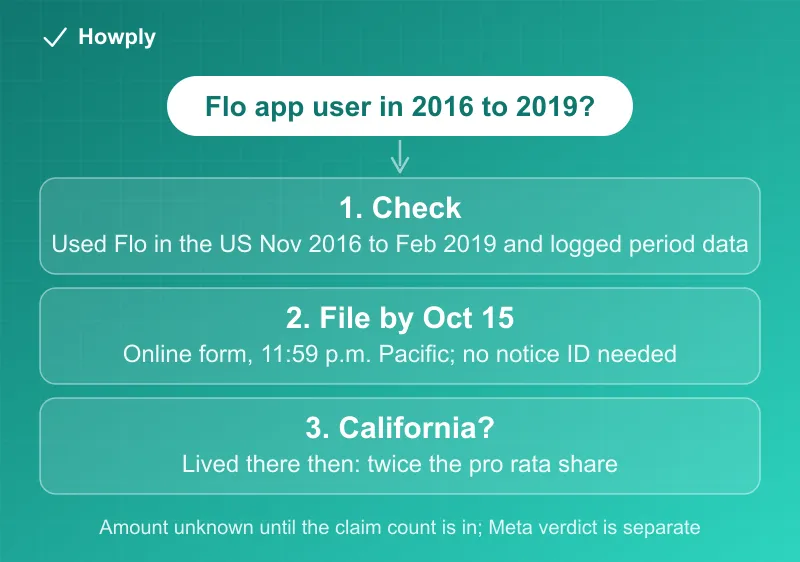
- Who qualifies: “Individuals who used the Flo App in the United States between November 1, 2016 and February 28, 2019, and entered menstruation and/or pregnancy information into the Flo App during that time”
- Deadline: online “by no later than 11:59 p.m. Pacific Time on October 15, 2026,” or a paper form “postmarked no later than October 15, 2026”
- No notice needed: the online form has an optional Unique ID and PIN field, “not required to file a claim.” You attest under an electronic signature that you used the app and entered that information
- The money: “Google agreed to pay $48,000,000, Flo agreed to pay $8,000,000, and Flurry agreed to pay $3,500,000,” paid pro rata after fees and costs. The notice says “we do not know precisely how much each Authorized Claimant will receive”
- California pays double: claimants who show they lived in California and used the app there in that window “will receive twice the pro rata share” of everyone else
- Meta is separate: the jury verdict against Meta on August 1, 2025 is not part of these settlements, and filing this claim “will not impact your right to receive money from the Meta verdict”
- Payment is digital: after validation the administrator emails or texts you to pick “PayPal, Venmo, Apple Pay, Amazon, or direct deposit,” with a paper check as an option
Key facts at a glance
| Item | Detail |
|---|---|
| Case | Frasco, et al. v. Flo Health Inc., et al., No. 3:21-cv-00757 (N.D. Cal.) |
| Settling defendants | Google ($48,000,000), Flo Health ($8,000,000), Flurry ($3,500,000) |
| Class period | November 1, 2016 through February 28, 2019 |
| Who is in | US users of the Flo app in that window who entered menstruation or pregnancy information |
| California subclass | Same, while living in California; “twice the pro rata share” with reasonable documentation |
| Claim deadline | October 15, 2026, 11:59 p.m. Pacific online, or postmarked that day |
| Objection deadline | October 8, 2026 |
| Opt-out | Closed; the deadline “was July 20, 2025 and has passed” |
| Final approval hearing | October 29, 2026, 11:00 a.m. Pacific |
| Per-person amount | Not final; the administrator’s October 22 estimate is about $60 to $63, or $120 to $126 for the California subclass, if all requested fees are awarded |
| Official site | periodtrackerdataprivacylitigation.com (administrator A.B. Data, 1-866-778-9626) |
What the case is about
The long-form notice describes the allegation in one sentence: between November 1, 2016 and February 28, 2019, “Flo incorporated code from Flurry, Meta, and Google’s SDKs in the Flo App, through which Flo allegedly shared information with Flurry, Meta, and Google, among others, related to Flo App users’ menstruation and/or pregnancy.” The claims that survived to trial were under Section 632 of the California Invasion of Privacy Act, which is why California residents are treated differently below. Flo, Flurry, and Google “deny all of Plaintiffs’ allegations and assert they did nothing wrong,” and the court “did not decide” who was right; the settlements end the case against those three without a ruling.
Meta went a different route. The notice explains that “a trial between Plaintiffs and Meta concluded on August 1, 2025, and the jury returned a verdict in favor of Plaintiffs.” That verdict is a separate track with its own process, and the notice is explicit that whatever you do about these settlements “will not impact your right to receive money from the Meta verdict.” So a Flo user who files this claim is not giving up anything on the Meta side, and a Flo user who ignores this claim gets nothing from Google, Flo, or Flurry.
Who qualifies, in the court’s words
The settlement site defines two groups. Class Members are “individuals who used the Flo App in the United States between November 1, 2016 and February 28, 2019, and entered menstruation and/or pregnancy information into the Flo App during that time, unless excluded.” California Subclass Members are “individuals who used the Flo App while living in California between November 1, 2016 and February 28, 2019 and entered menstruation and/or pregnancy information into the Flo App during that time.”
Three things follow from that wording. First, the window is closed at both ends: someone who downloaded Flo in mid-2019 or later is not in the class, however long they have used it since. Second, using the app is not enough on its own; you must have entered period or pregnancy information, which describes nearly every real user of a period tracker but is the fact you attest to on the form. Third, residence is measured then, not now. A person who lived in California in 2017 and moved to Texas since is a California Subclass Member; a person who moved to California in 2020 is not.
The exclusions are the standard ones: the judge and family, the defendants and their employees, class counsel, and “individuals who properly executed and filed a request for exclusion from the Class by July 20, 2025.” That opt-out window is over, so anyone still in the class is bound by the settlement whether or not they file.
What the claim form asks
The online claim form takes a few minutes and requires no upload. It asks for:
- Your current name and address (no P.O. boxes), plus an email and phone number, which the administrator uses “for all communications relevant to this Claim Form”
- Your address between November 1, 2016 and February 28, 2019. This is the field that establishes where you lived during the class period, and it is required
- An optional Unique ID and PIN, only if you received one in a notice. The form states this “is not required to file a claim,” so people who never got an email can still file
- The California question: “At any time between November 1, 2016 and February 28, 2019, did you live in the state of California and enter menstruation and/or pregnancy information into the Flo App during that time?” Yes or No
- A payment preference, with the site noting that “all information about payments will be sent to you digitally”
- An electronic signature under the attestation that you “lived in the United States and entered menstruation and/or pregnancy information into the Flo App during that time”
Answer the California question honestly, because it changes the payout and can be checked. The notice says California claimants “who provide reasonable documentation showing they are also members of the California Subclass will receive twice the pro rata share,” so expect the administrator to rely on the class-period address you give and, possibly, to ask for more. A paper form is available on the court documents page for anyone who prefers mail, postmarked by October 15.
How much you might get, and why nobody knows
The site’s FAQ puts the fund at $59,500,000 and says it “will be used to compensate eligible Class Members who submit valid and timely Claim Forms, and to pay for notice and settlement administration costs, taxes, service awards for representative Plaintiffs, attorneys’ fees, and litigation expenses.” What is left after those deductions is the Net Settlement Fund, and “each Authorized Claimant will receive a pro rata (or proportional) share” of it, with California subclass members counted at double weight.
The notice’s own answer to “How much will my payment be?” is that “we do not know precisely how much each Authorized Claimant will receive from the Settlements or when payments will be made.” It names four drivers: the number of timely valid claims, the fees and expenses the court approves, California subclass membership, and the plan of allocation the court approves. Flo had a very large US user base in those years, so the per-person figure was always going to be set by how many valid claims came in.
That count arrived on October 22, 2026, in a declaration from the administrator, A.B. Data. By the October 15 deadline it had received 22,238,137 claim forms, all but 11,069 of them online. A fraud-screening firm’s first pass sorted them this way: 461,766 not fraudulent, 78,654 showing signs of fraud that are not conclusive, 256 without enough data to process, and 21,697,461 fraudulent. The fraudulent group is still under a final audit, and about 728,116 of those claims are being re-examined. Against an estimated class of 9,961,995 people, the declaration puts the claims rate at about 4.6%. It also reports 72,843 late claim forms, which will be counted only if class counsel and the court allow it.
From those numbers the administrator estimates the payment, assuming the court grants every requested fee: a net fund of about $34 million, shares of about $60 to $63 for most claimants, and $120 to $126 for the California subclass, which is paid at double weight. The class counsel fee request in that math is $19,366,666.67, about 32.5% of the fund, and administration costs are $3,556,087.39 so far with about $325,000 more expected. The court can change any of these when it rules. The fee motion filed August 20, 2026 is on the court documents page if you want to see what class counsel is asking the court to deduct.
The timeline after you file
- October 8, 2026: last day to object. Objecting does not remove you from the class, and only class members can object
- October 15, 2026: claim deadline, 11:59 p.m. Pacific online or postmarked that day
- October 29, 2026, 11:00 a.m. Pacific: final approval hearing before the court in the Northern District of California. The judge can approve the settlements, adjust the fee request, or send the parties back
- Identity checks, now: the 78,654 flagged claims, plus any moved out of the fraudulent group in the audit, get a deficiency notice asking for documents or information that establish the claimant’s identity. The declaration says claims with no response, or a response that does not resolve the concern, will be denied
- After approval and any appeals: the administrator validates claims, then sends “an email or text from A.B. Data to choose a digital payment.” The notice asks claimants to “please be patient,” and its own timing answer is that payment comes only after appeals, “if any, are resolved”
Because the payment step starts with a message from the administrator, keep the email address and phone number on your claim current. The site says you can contact A.B. Data to update your information if something changes after filing, and the phone line is 1-866-778-9626.
Two things to avoid
Do not pay anyone to file this. The form is free and takes minutes. A message offering to “process your Flo settlement” for a fee, or asking for a card number or gift card to release funds, is not from the administrator. The only site is periodtrackerdataprivacylitigation.com, and payment choices are made through the administrator’s own message after validation, not through a link in an unsolicited text. The same goes for the identity-check notices described above: before sending documents in reply to one, confirm the request through the official site or the administrator’s phone line.
Do not file for the Meta verdict here. The claim form covers the Google, Flo, and Flurry settlements only. Whatever process eventually pays the Meta verdict will be announced separately, and the notice confirms your rights there are untouched by this claim. If you filed a claim in another Flo-related matter, or received a different notice, read it against the case number above, 3:21-cv-00757, before assuming it is the same thing.
Bottom line
If you used the Flo app in the United States at any point from November 2016 through February 2019 and logged a period or a pregnancy, you are in this class, and the only way to be paid from the $59.5 million Google, Flo, and Flurry settlements is the free online form by 11:59 p.m. Pacific on October 15, 2026. No notice ID is needed. Answer the California residency question accurately, because California claimants receive double, and expect the amount to stay unsettled until the court rules after its October 29 hearing; the administrator’s October 22 estimate is about $60 to $63, or $120 to $126 in California. Our refund timing guide covers what “after final approval” usually means in months.
Quotes from the court-authorized settlement website, online claim form, and Long Form Notice administered by A.B. Data, linked above, read on September 16, 2026, with the site FAQ, deadlines, and hearing date rechecked on September 30, 2026. The claim counts, fraud review figures, late claims, payment estimates, fee request, and administration costs are from the administrator’s declaration on notice plan implementation and plaintiffs’ reply, both filed October 22, 2026 and read on the court documents page on October 29, 2026. If the final approval hearing changes the terms or timeline, this page will be updated with the date. This is general information, not legal advice.
Official sources
- Frasco v. Flo Health settlement site (A.B. Data): eligibility, deadlines, FAQ
- Flo settlement: online claim form
- Flo settlement: Long Form Notice (class definitions, plan of allocation, Meta verdict)
- Flo settlement: court documents (settlement agreements, final approval motion)
- Flo settlement: administrator declaration on notice plan implementation, claim counts and payment estimate (Document 861, filed October 22, 2026, PDF)
- Flo settlement: plaintiffs' reply in support of final approval (Document 860, filed October 22, 2026, PDF)